I took a lot of photographs on a recent visit to the Kenedy Space Center. On a previous visit, I had some challenges in taking photographs that showed the scale of some of the items that were there. This time, I travelled with someone that was able to hold my camera.
Outside the Atlantis Space Shuttle exhibit they have a 1:1 scale representation of the shuttle’s boosters and fuel tank. I had my travel companion while I held the camera and ran up to the booster. I think this gives a better scale. What do you think, does this give an idea of scale?
UPDATE: The launch is now delayed until 17 May to give time to replace O2 pressure regulation valve.
Boing is going to make a second attempt to launch its Starliner manned spacecraft. The first attempt was scrubbed because of a stuck valve. The next attempt is scheduled for Thursday 8 May at about 10:11 PM. Emphasis on “Attempt” because there is no guarantee that it will happen. The craft is capable of holding up to 7 people. But for this test flight there will only be three people. Barry Willmore, 61, is a NASA astronaut and former U.S. Navy Captain that will be in command. Sunita Williams, 58, is a former Navy server member, will be piloting. The flight plan for the Starliner includes a stay at the International Space Station for a week before returning the astronauts. If this launches, this will be Boeing’s first manned space flight.
This won’t be the first flight of the spacecraft itself. It first launched in 2019, but failed to rendezvous with the Space Station because of a software error. It was successful in a launch in May 2022. Though after that flight Boeing decided to change the type of tape used on the electrical cables to a material that was more fire resistant since then.
The Whitehouse has sent NASA orders to develop a lunar time zone. At first glance, some might think that this is silly. There are no people on the moon, why is a time zone needed? While it is easy to coordinate time on earth, coordinating time between the earth and moon is a bit different because of the effects of gravity/mass on the passage of time. The moon has less mass than the earth, resulting in time passing at a different rate. The difference in the rate of the passage of time is tiny, but can be significant when working with high-precision clocks. A clock on the moon and earth would drift apart by about 58 microseconds per day.
NASA was asked to come up with the system for Lunar Coordinated Time by the end of 2026. The efforts will include contributions of international bodies and the 36 nations that are part of the Artemis Accords. This will add to the systems of time used in astronomy such as a solar day, mean solar day, sidereal day, and the 11 time zones on Mars.
Posts may contain products with affiliate links. When you make purchases using these links, we receive a small commission at no extra cost to you. Thank you for your support.
If you are in the United States or Mexico, come Tuesday 8 April you might be able to view a total solar eclipse. Even if you are not in the path of totality, you might have an opportunity to view a partial eclipse. If you are interested in viewing, the key pieces of information you need are when it will be, where it can be viewed, and what you need for viewing. It isn’t too late just yet to get viewing equipment (if you are interested in any). But if something shows a delivery date of Monday, consider it something that will likely not arrive in time.
When and Where
The time at which you can see the eclipse will vary by location and timezone. NASA has in which you can enter a zip code and get the information for your location. Even if you are not in the path of totality, you might be able to see a partial eclipse.
Location
Partial Begins
Totality Begins
Maximum
Totality Ends
Partial Ends
Dallas, Texas
12:23 CDT
13:40 CDT
13:42 CDT
13:44 CDT
15:02 CDT
Idabel, Oklahoma
12:28 CDT
13:45 CDT
13:47 CDT
13:49 CDT
15:06 CDT
Little Rock, Arkansas
12:33 CDR
13:51 CDT
13:52 CDT
13:454 CDT
15:11 CDT
Poplar Bluff, Missouri
12:39 CDT
13:56 CDT
13:56 CDT
14:00 CDT
15:15 CDT
Paducah, Kentucky
12:42 CDT
13:59 CDT
14:01 CDT
14:02 CDT
15:18 CDT
Carbondale, Illinois
12:42 CDT
14:00 CDT
14:01 CDT
14:03 CDT
15:18 CDT
Evansville, Indiana
12:45 CDT
14:02 CDT
14:04 CDT
14:05 CDT
15:20 CDT
Clevland, Ohio
13:50 EDT
15:13 EDT
15:15 EDT
15:17 CDT
16:29 EDT
Erie, Pennsylvania
2:02 EDT
15:16 EDT
15:18 EDT
15:20 EDT
16:30 EDT
Buffalo, New York
14:04 EDT
15:18 EDT
15:20 EDT
15:22 EDT
16:32 EDT
Burlington, Vermont
14:14 EDT
15:26 EDT
15:27 EDT
15:29 EDT
16:37 EDT
Lancaster, New Hampshire
14:16 EDT
15:27 EDT
15:29 EDT
15:20 EDT
16:28 EDT
Caribou, Main
13:22 EDT
15:32 EDT
15:33 EDT
13:34 EDT
16:40 EDT
What do you need for viewing?
There are a lot of options for equipment. The simplest option would be a pinhold projector or some variation of it. To make one of these, you only need a stiff piece of material, such as cardboard, and a white sheet of paper. Drill a hold in the center of the cardboard. If you aim the hold for the cardboard at the sun and place the paper behind it with a decent gap between them, you’ll see a circle of light on the carboard. That’s a projection of the sun. As the eclipse progresses, it will be more apparent that this is an image of the sun as you see the sape of the moon encroching on the projection. This solution isn’t much different from the earliers cameras (Camera Obscura), which were made by cutting off all light sources in a room except for one edge with a hole or lens. The image of what is going on outside the room is projected on the wall opposite to the hole.
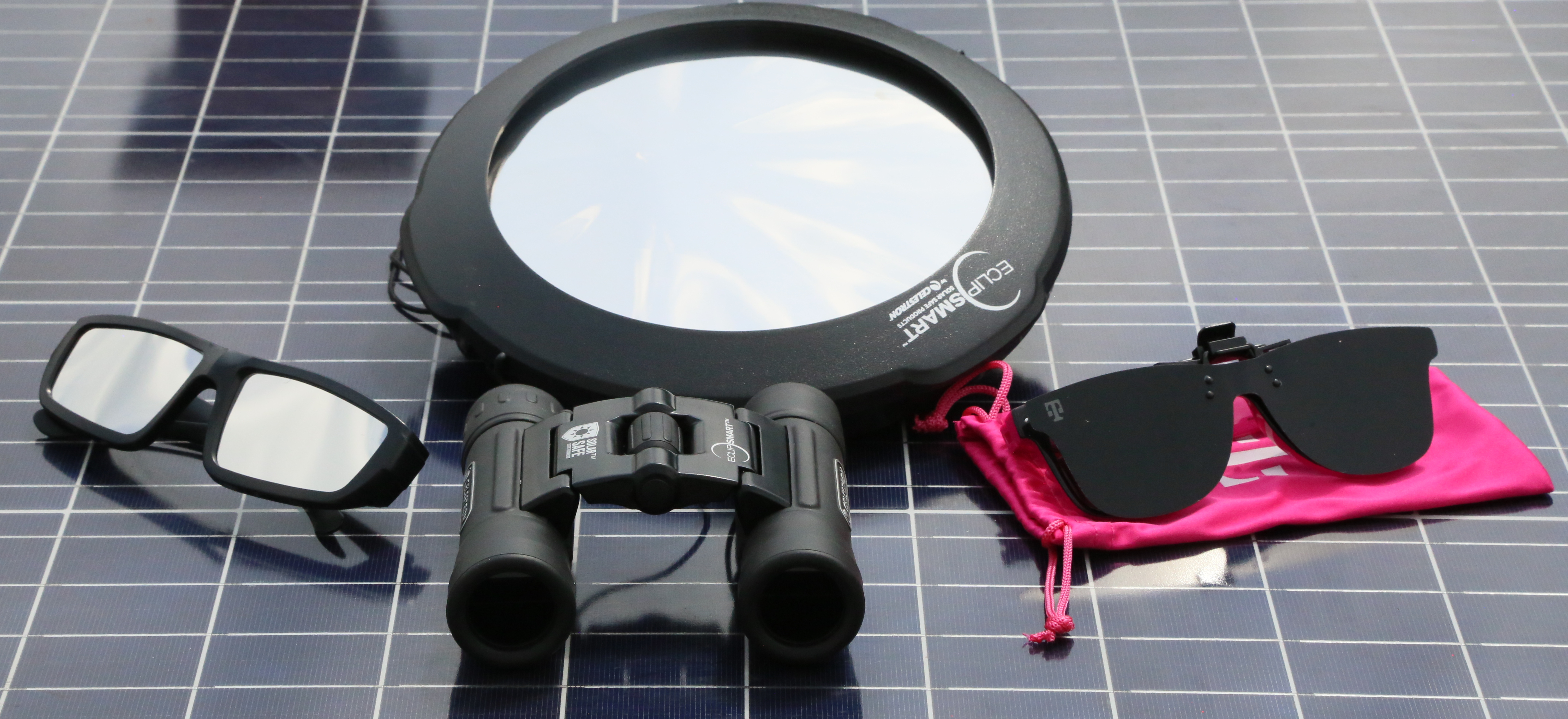
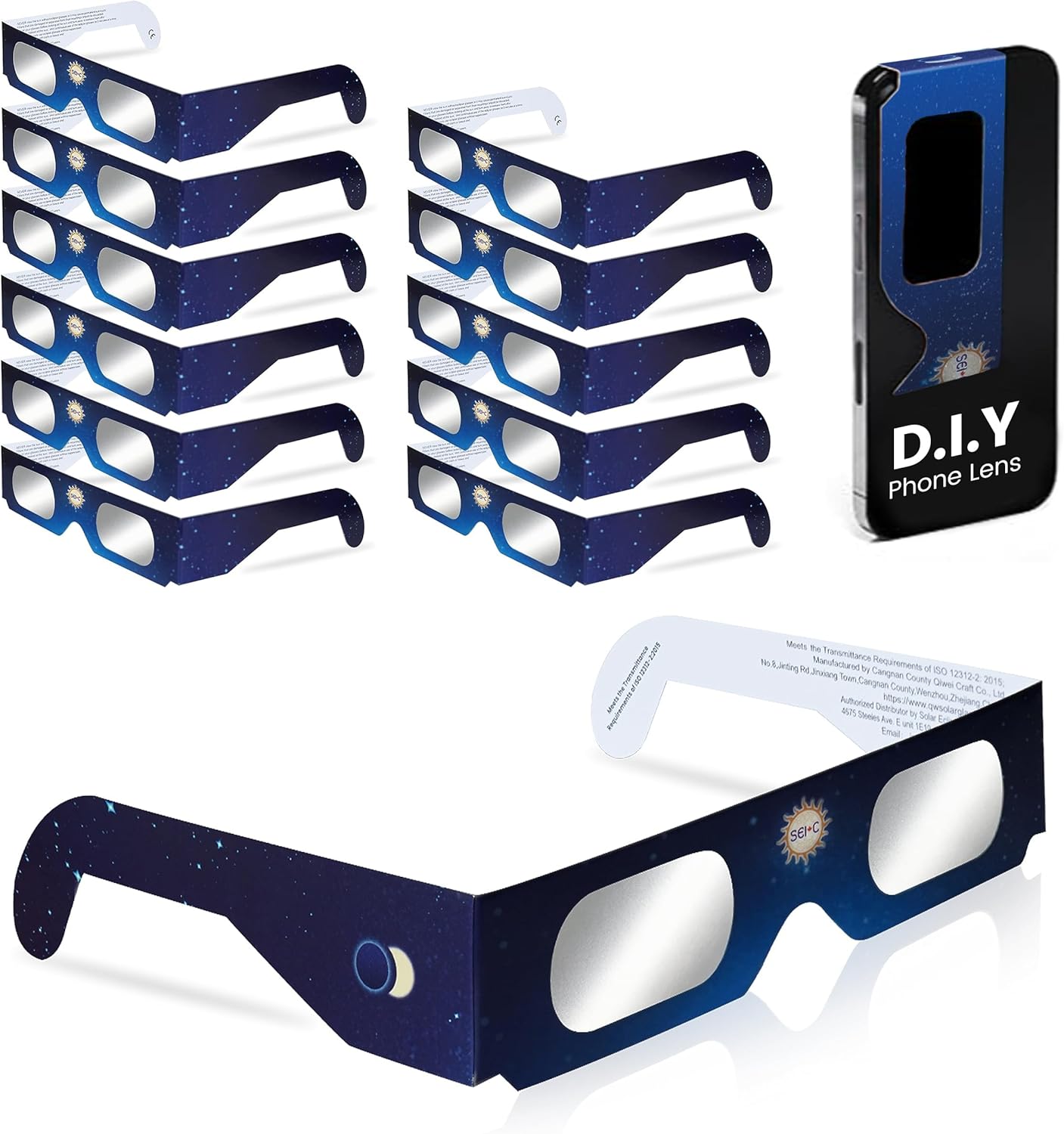
The next step up for viewing would be to have solar viewing glasses. These are usually have cardboard frames with a thin plastic where lenses would go. Though either absorption or reflection, these glasses prevent an overwhelming majority of the light from reaching your eyes so that you can safely view the image. They are as cheap as 0.80 USD for disposable units and as much as 7 USD for some of the studier ones. If you are a T-Mobile subscriber, you might have grabed some solar glasses for T-Mobile Tuesday for free.
If you plan to use your smartphone to take pictures, you might run into a challenge if you try to put the glasses in front of your phone. Even if you zoom for your phone’s camera to use a specific lens, some phones will still switch lenses based on changes in lighting conditions. It may be easier to get a silter specificly made for the phone.
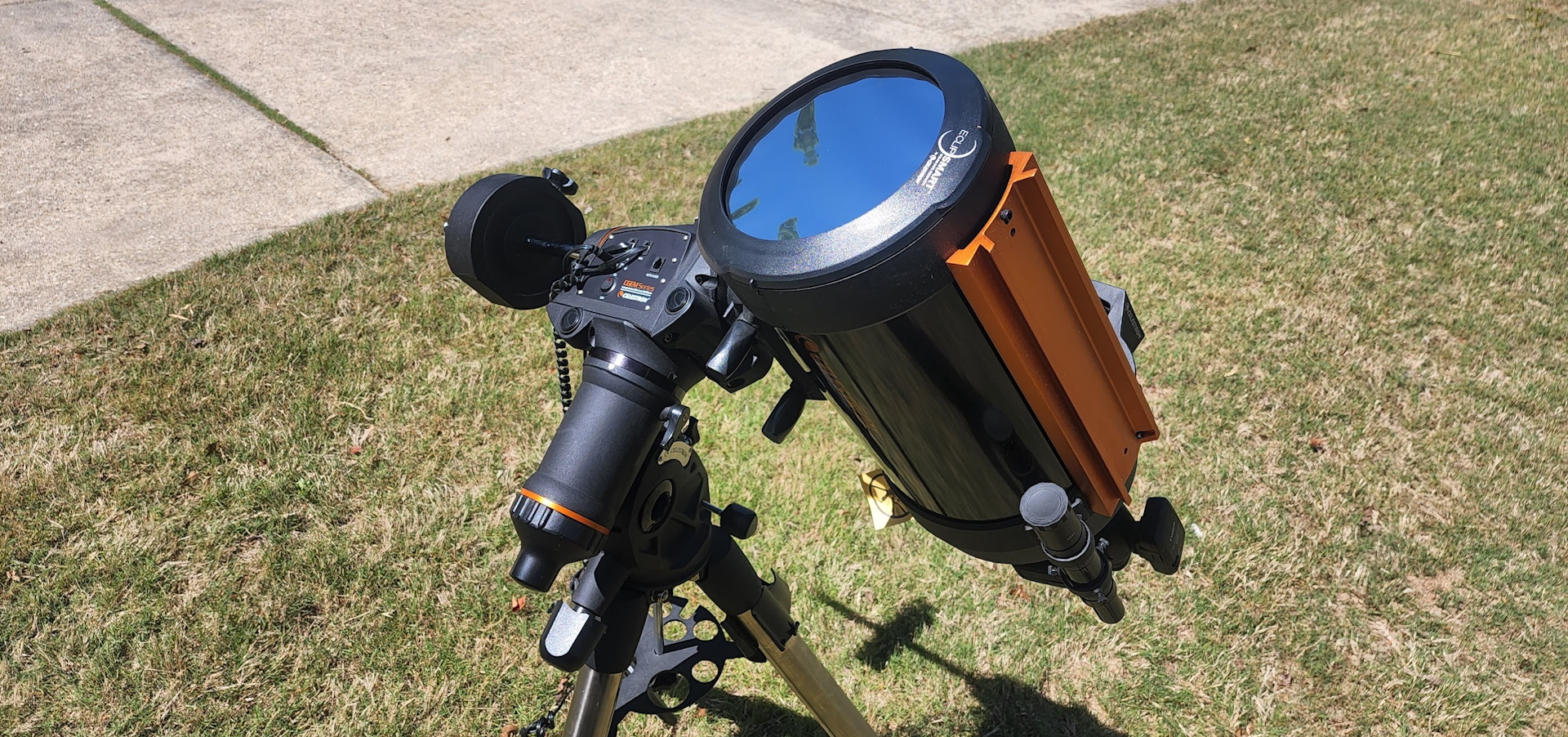
Beyond glasses, there are magnifying devices or viewing the eclipse. The least expensive of these would be eclipse binoculars. These darkened binoculars give you a much more dramativ perspective of the show. On the higher end of this, there are telescopes that have been fitted with solar filters (similar to the glasses). This would be an option to considere only if you already have a telescope. Keep in mind that if you are using a regular telescope, do not use a viewfinder to aim the scope. That would be a great way to cause eye damage. Instead, keep the caps on the viewfnder so that it is blocked and put a sheet of paper behind the viewfinder. When it is aimed properly, the sioulette of the viewfinder will be a perfect circle.
Finishing Preperations
Check your local weather before monday. If you know the weather might not be good, you may be less disapointed if and when it doesn’t allow viewing. If you have the option, make it a work from home day. Remember to block your calendar around the time of the eclipses maximum. If you plan on viewing away from home, load your glasses into your car so that they are not forgotten. If you plan to order viewing equipment, make sure you have it in hand by Sunday!
Posts may contain products with affiliate links. When you make purchases using these links, we receive a small commission at no extra cost to you. Thank you for your support.
In the interest of ensuring humanity doesn’t follow the pathway of the dinosaurs, NASA engaged in a mission known as DART recently. The purpose of the DART mission was to determine if it was possible to change the trajectory of an asteroid to prevent it from impacting earth. The asteroid chosen wasn’t endangering earth and was selected only for testing. The pair of asteroids observed are named Didymos and Dimorphus. Didymous completed orbit around Dimorphus every 11 hours and 23 minutes. If NASA successfully affected the trajectory of Didymous, they expected it to alter the orbit by about 10 minutes. The effect that the impact had was that it altered the orbital period by 32 minutes. This makes for the first time that humans have altered the orbit of a celestial body.
The orbit was altered by impacting a space vehicle into the asteroid at a speed of 22,530 kilometers per hour. Of course this destroyed the spacecraft itself. Though the mission was successful, the observations are ongoing. In another 4 years, the ESA (European Space Agency) has a fly-by planned to collect more information.
In the event of a threatening asteroid, the expectation on how it will be altered is that if it is discovered early enough, that an impactor flying into it could alter its trajectory enough so that it is not a threat to life here on earth.
Posts may contain products with affiliate links. When you make purchases using these links, we receive a small commission at no extra cost to you. Thank you for your support.
On 25 December 2021, the James Webb Telescope (JWT) launched. This last month up to the launch had a couple of delays due to weather and an incident for which they had to ensure there was no damage. At the time that I am writing this, the JWT has not yet been brought up to full operation. But thus far, things have been going well. The JWT is often thought of as the successor to the Hubble telescope. Some call it a replacement, but its capabilities are not identical to that of Hubble. It was designed based on some of the findings of Hubble. I’ve got some readers whose living memory does not go back as far as the Hubble telescope. Let’s take a brief walk-through history.
Rendering of the James Webb Telescope
Edwin Hubble (the person, not the telescope) is most well-known for his astronomical observations and discoveries. Some of his discovers included that there were galaxies beyond the Milky Way, found methods to gauge cosmic distances, and discovered that the further aware from earth that an observed galaxy is, the faster that it is moving away from other galaxies (this is known as “Hubble’s Law”). Edwin Hubble performed many of his observations using what was then the world’s largest telescope, named after James D. Hooker. Naming large telescopes after people was a bit off a tradition.
The Hubble Telescope
Space telescopes were proposed in the early 1920s. As is the case with many high investment scientific endeavors, Hubble’s planning was a joint venture that crossed international borders. The USA’s NASA and the European Space Agency both made contributions to Hubble. The project was started in the 1970s with plans to launch in 1983. There were delays that prevented this. But it finally launched in 1990. Much to the disappointment of many, after launch it was discovered that the Hubble’s main mirror was incorrectly manufactured; the telescope was taking distorted images. It was possible to use software to make some corrections in the image, but servicing was needed to correct the problem. Hubble, being positioned in low earth orbit, was accessible to astronauts by way of the space shuttle. A few years after its launch in 1993 a servicing mission corrected the optical problems. Through several other missions Hubble was maintained and upgraded until 2009. The telescope had been used for over 30 years. The telescope is still partially operational now. Some of the gyroscopes have failed as has one of the high-resolution cameras. But some other cameras and instruments are still operational. A near-Infared telescope is functional but remains offline for the time being. It is expected to be able to maintain functionality until 2040.
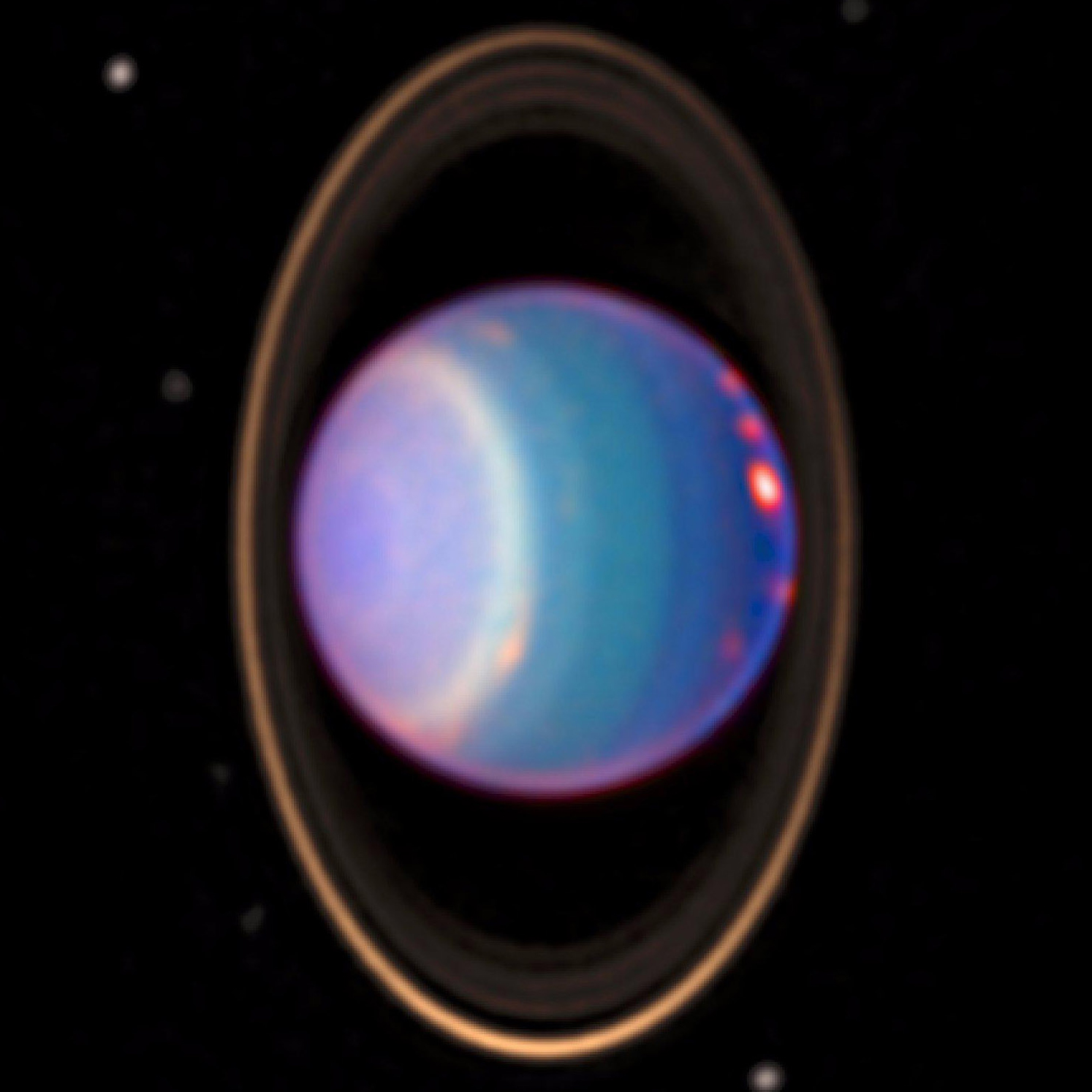
The Plane Uranus as seen in Near Infared
While Hubble was operating in its earlier years, plans for its successor had begone. Planning for the James Web Telescope began about 1996. The year prior, in 1995, was the Hubble Deep Field photograph. The Hubble telescope was aimed at a dark patch of sky and took a long exposure photograph. For 10 days the telescope collected whatever bits of light that it could. The result was an image that was full of galaxies! Around 10,000 galaxies were observed through the deep field imaging. Visible, infrared, and ultraviolet wavelengths were used in the imaging.
Hubble Deep Field Image
Earlier I mentioned Edwin Hubble’s discovery of how galaxies further aware are recessing from earth at a faster rate than ones that are closer. The faster the galaxy is moving away, the more red-shifted the light from it is. Red shifting is a form of the doppler effect observed on light. Just as the pitch of a sound will be higher in pitch if it is moving toward and observer and lower in pitch when it is moving away, visible light shifts to become red if the source is moving away from an observer and blue if it is moving closer. Part of the purpose of the JWT is to make observations of astronomical bodies much more distant than the Hubble could. Since these bodies will be more red shifted, the JWT was designed to be sensitive to light that is red shifted. While both the Hubble Telescope and JWT have infrared capabilities, the JWT is designed to see light that is much more red. Because of this goal, the JWT has some rather unusual elements of design and constraints.
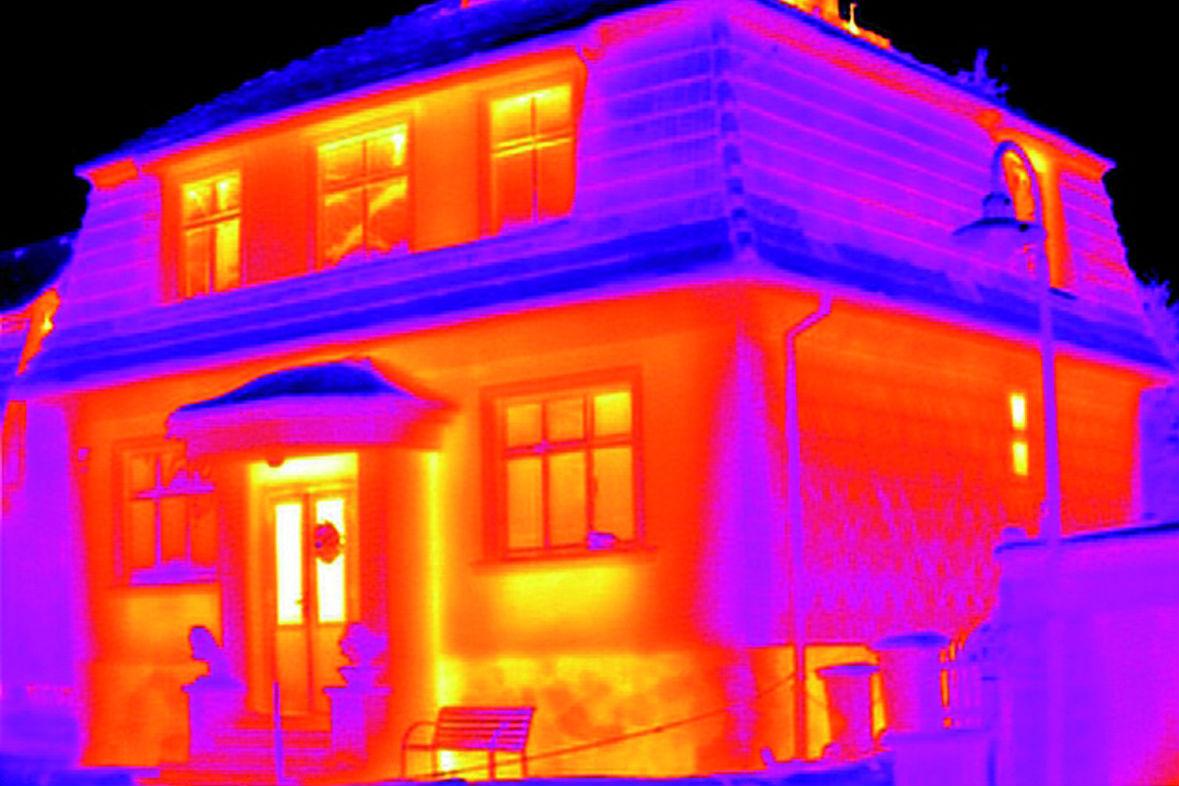
Objects radiate their heat out as electromagnetic waves. For objects that are hot enough, we are able to see this radiation as light; a hot piece of metal may glow red or orange. Objects with no glow in visible light may still give off light in the Infared spectrum. Such objects include the earth and the moon, which reflect infrared from the sun and emits heat.
Infrared Photo showing heat leakage from a house
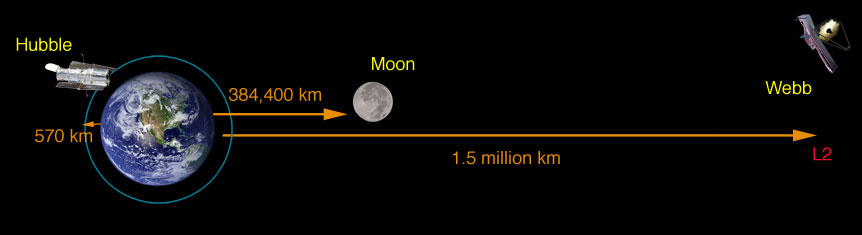
The Hubble was positioned in low earth orbit, about 570km above earth. The moon is about 385,000 km from earth. To avoid the glow of the earth and moon, the JWT is much further aware at 1,500,000 km. The Hubble was in orbit around the earth, but the JWT isn’t really in orbit. It is in a Lagrange point. Objects positioned in a Lagrange point tend to stay in position with very little active adjustments needed.
Relative distances from earth. Image from NASA.gov.
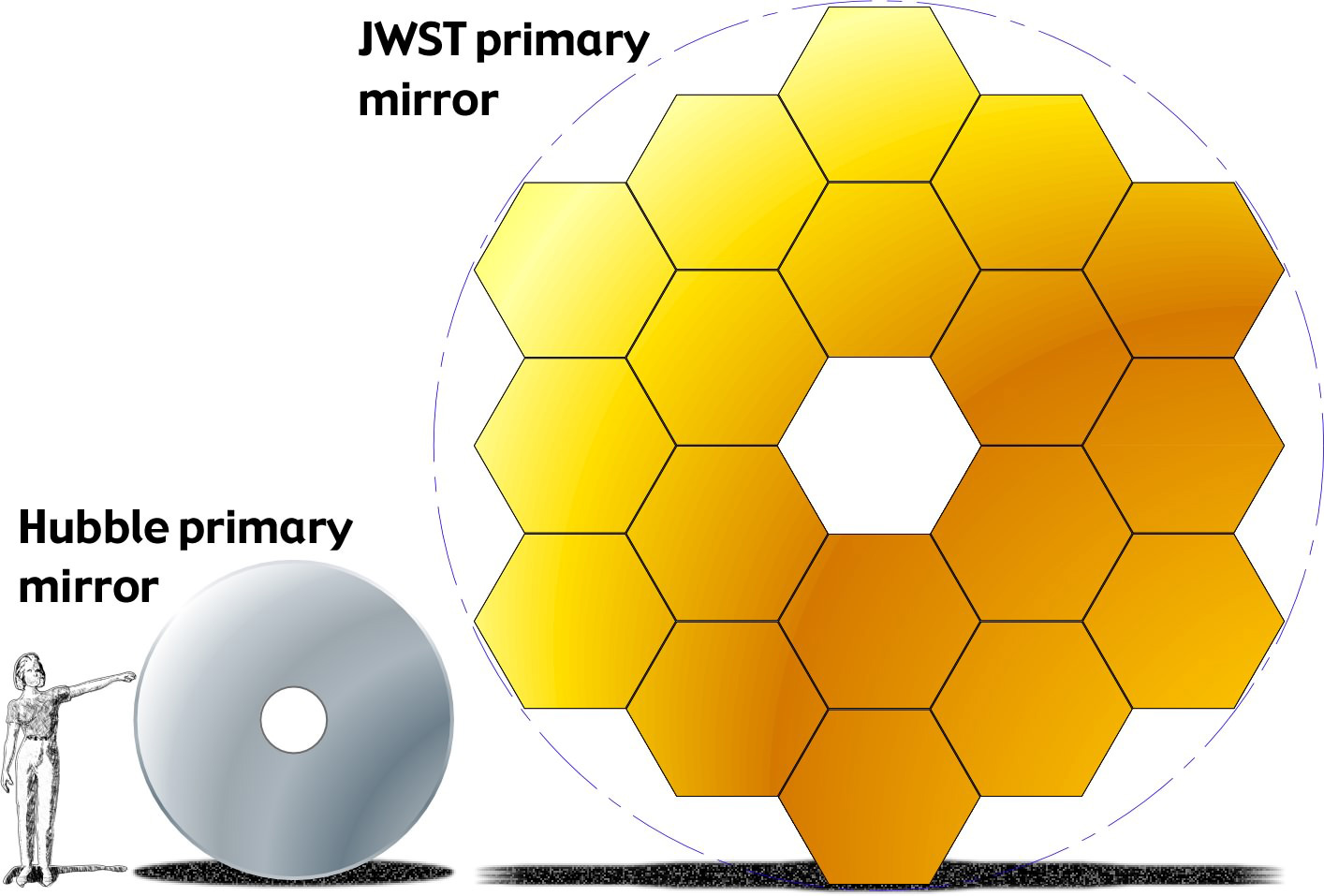
The telescope is still exposed to the sun, which would potentially heat the telescope up and cause the telescope to have its own glow that would interfere with imaging. To prevent the sun from being a problem, the telescope has a multilayered shield on the portion that is facing the sun. The shield is designed to reflect light away and to dissipate heat before it reaches the imaging elements of the telescope. Another unique element of the telescope is the exposed reflector. The reflector is composed of several hexagon-shaped mirrors coated in gold. Gold reflects infrared light very well. Using hexagon segments for the mirror simplifies manufacturing and allows the elements to be more easily folded; the telescope was launched in a fairing with the mirror folded and the sunshield sandwiched over the mirror.
Folded James Webb Telescope.
The JWT’s field of vision is much wider than that of Hubble. It collects about 15 times more light than the Hubble and has a wider field of view. The telescope’s look stands out in that there is no tube wrapped around the optical elements. Optical tubes on terrestrial telescopes protect the elements from debris and stray light. Because of the telescope’s sun shield and its position, it won’t be exposed to stray light from the sun. I’ve not been able to find references on any concern for the mirror being exposed to debris in space (despite being a hard vacuum, it isn’t without debris) but unlike on earth, there are not concerns with it collecting dust. With these differences in design and capabilities and design, what are the plans on how this telescope will be used?
Comparison of Hubble and JWT mirror size, from NASA.gov
While I’m not a fan of this description, I often see its purposed summarized as “looking back in time.” Despite my dislike of this description, it isn’t inaccurate. Light takes time to travel. If you look toward the moon, the light reflected from the moon took 3 seconds to travel to your eyes. You are seeing how the moon looked three seconds ago. For the sun, it’s eight minutes ago. These bodies to change dramatically enough for the delay to make a significant difference. But as we look at bodies that are further away, the time it takes to travel becomes more significant. From Mars to earth is about 22 minutes. Jupiter to earth is about 48 minutes. It takes a few hours for light to travel between Pluto and earth. For other galaxies, light takes years. While light-years is a unit of distance, it also tells you how long it takes for light to travel from a body. The JWT’s light collection capabilities make it capable of seeing light far enough aware to collect information on the earlier universe. The Hubble telescope was able to collect information on the universe from about ~13.4 billion years ago while the James Webb Telescope is expected to collect data from about 13.7 billion years ago. That 300,000,000 difference
As of yet, the James Webb Telescope hasn’t taken its first image. This is about 4 days after launch. It has deployed the sun shield. It will take about another 25 days for the telescope to reach its intended position. Before then, the mirror segments must be unfolded into place. If you are waiting to see images from the JWT, it will be a while. There’s calibration and preparation needed. Other than test images, we might not start seeing full images for another six months.
If you want to keep track of where the telescope is and its status, NASA has a site available showing the tracking data.
James Webb Telescope Tracking Site
Developments on the James Webb Telescope will be slow to come at first, but it should be interesting.










 j2i.net