Yes, in the USA we still use magnetic strip on credit cards.
I’ve had some interactions with some people online more than once when I found myself explaining this. One of the more recent incidents was about a phone that used magnets to keep something in place. I had commented that with such a phone I want to make sure that it didn’t get near my bank cards because of the magnets. I received responses of confusion from this. I’ll address some of the frequent responses.
Why does it matter if it gets near a magnet?
– If a credit card is in contact with a magnet that is strong enough or for long enough then the data on the strip can be damaged making it unusable in magnetic strip readers.
Why not use contactless payment?
Banks in the USA for the most part don’t issue contacless cards. I’ve checked for them and have found they do exists if you get a very “product” from that bank. For example if you have a card from Main Street Bank Visa (a bank name I’ve just made up) then it might not be contactless, but if you got the Main Street Bank Visa Barbie Edition (also a made up card) then it may have the contactless feature.
Why not use the Chip and Pin
The chip isn’t accepted at some POS terminals. For credit cards in the USA we almost never use pins. For bank cards associated with a checking account though a PIN must be entered if the card is processed as a bank card instead of a credit card. High volume stores including fast food also prefer not to use the pin. The amount of money they can make is heavily dependent on how quickly they can complete the purchase process and they risk loosing money on missed sales than fraud at heavy times.
Typically, people in the USA that do have experience with contactless payment have it through Apple Pay or Samsung Pay. While Android Pay had been present years before it was hamstrung by three of the four nationwide phone carriers here. They decided to block Android pay and created their own payment system. Their system was called ISIS and based on the American Express SERVE cards. But things happened in the news and the ISIS name was no longer a name that was marketing friendly. They changed the name to Softcard but the effort ultimately failed.
I myself was able to use Android Pay for some time since I had a Google phone that wasn’t distributed through the carriers. It worked fine until Apple Pay was released. When Apple Pay was released many major retailers decided to deactivate their contactless receivers. They wanted to have in on mobile app payments and they blocked such payments all together. Now, if I entered a store even if I could visually identify that a contactless payment terminal was present I didn’t know that it worked. At one point it failed more times than not and it was easier to just not bother with it.
Why not use the app that the retailer made instead of the phone payment app? There are two reasons. The first, is the retailers didn’t have such an app. They were starting development of their systems and blocked other contactless payments while they prepared their own. When such apps were available my personal motivation was that data breaches happen regularly and it is safer to minimize the number of accounts in which personal information appears. Even when an account is closed in the USA retailers may often retain records of the information; it is still vulnerable to a breach after an account with the retailer has been closed.
With that said, I’m hoping to see a shift in how credit cards are handled in the USA. There’s a high rate of credit card fraud in the USA and several times within a year my associates and I find that we must get a card replaced because of data breaches.
The modern Samsung TVs run the Tizen operating system. You can develop for these just as you might develop for the Tizen based watches. The Tizen TVs are locked down more than the watch is. To deploy to a Tizen TV you’ll need to both enable developer mode and will have to let the TV know from what address it will be receiving code. If it receives request from other addresses it won’t respond to them.
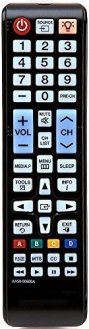
On the consumer displays there is no obvious way to enable developer mode. The option is hidden. If you open the apps browser (for seeing what other apps there are to install) you can open the developer mode menu by entering “12345” on the remote. A popup window will show from which you can select to turn developer mode “On.” If you are using one of the commercial displays (SSSP, or Samsung Smart Signage Platform) the method to enable developer mode is more obvious. If you open the TV’s menu there is an option called URL Launcher Settings. The developer mode option is within these settings.
On the consumer devices you’ll also be asked to enter the IP address of the machine from which the development will occur. This prevents other rouge devices on your network from doing anything to the TV. Here you should enter the IP address of your development machine.
After these options are set the TV needs to be rebooted before the changes are fully applied. you can do this by holding the power button on the consumer TVs for two seconds, holding the power off button on a SSSP display for 2 seconds, or removing the power source from the TV and reapplying it.
After the TV boots developer mode is now enabled. However the mode being enabled doesn’t mean that all of the conditions for deploying code have been met. You will need to generate a distributor certificate also. Samsung has this page with instructions for generating a certificate. In following these directions you will need the the Device Unique ID (DUID). To get this you first need to connect to the TV. I prefer to use the sdb utility that comes with the Tizen SDK. It is located in tizen-studio/tools (adjust this path according to the location at which you installed Tizen Studio). The syntax for connecting is:
sdb connect
Sometimes I have to type the command twice before it takes effect. After the connection is successful open the Tizen Device Manager. You should see the TV connection within the UI. If you right-click on the connection you will have the option of selecting the TV’s DUID. Select this option and copy the DUID to the system clipboard. Keep the DUID on the system clipboard and when it is needed during the certificate generation it will automatically be pasted where it is needed.
Creating a certificate based on the Device Uniuque ID (DUID) is slightly different for the two classes of displays. For the consumer displays a Samsung certificate should be created. For the commercial displays a Tizen certificate should be created. It can be a little confusing with Tizen being a Samsung creation. But you may be able to make better sense of it from another perspective. The Samsung certificate is associated with the Samsung App store. The consumer displays access the app store and the certificate rules for that are different than for apps that have no access to the App Store.
Samsung announced today at the annual Developer Conference that Bixby Studio, their developer tool for building natural language interactions, is available on all devices that support Bixby. Previously this functionality was only available on the mobile devices. With today’s announcement it is available on other devices such as the TV, Tizen powered refrigerators, and the watch.
To encourage developers to get started with Bixby development they’ve also opened a contest offering thousands of dollars in prizes. For more information on the contest visit BixbyDevJam.com.
There are two mistakes that one might make about the difference in consumer and commercial displays.
Mistake 1: Commercial Display are just Consumer Displays that cost More
This is an easy mistake to make because at first glance the displays may look alike. But commercial displays are made to withstand a wider range of conditions than their consumer counterparts. An illustration of this that comes to my mine is a display I worked on that was installed in an airport. When the display opened to the public we saw some abuses that we didn’t quite imagine. The installation included touch screens. We expected people to touch the screens. We didn’t expect people to set their children on top of the displays. Yes, this really happened. The displays survived the years that they were at the installation without problems, but I still consider some of what they endured to be borderline abusive. If a small child were set on a consumer display (do not do this) I’m pretty sure that it wouldn’t last long.
That is just one of the tolerances that a commercial display may have that it’s consumer counter part does not. The commercial displays may also have higher tolerance for moisture (perhaps even outdoor use), temperature, potentially higher potentially a brighter screen (as might be needed for outdoor use).
Commercial displays may have a number of features that the consumer counter parts do not. These may be additional connections (such as RS232), the ability to control several displays at once (as one might want to do in a video array configuration) and even internal media players or security features.
Mistake 2: A Commercial Display would make a good Home Display
This misconception comes from the idea that a commercial display is a consumer display with features added. The reality is that while the commercial displays may have additional features they might also be missing features that the consumer displays have. If you buy a typical consumer display above a certain size it will have the ability to run several consumer oriented applications such as a Netflix and Hulu player and a few others. The commercial displays don’t have this; and that is understandable since they are not for engaging in these consumer activities. A person that pays the extra money to get a commercial display may leave one feeling quite disappointed after realizing the features that are not available.
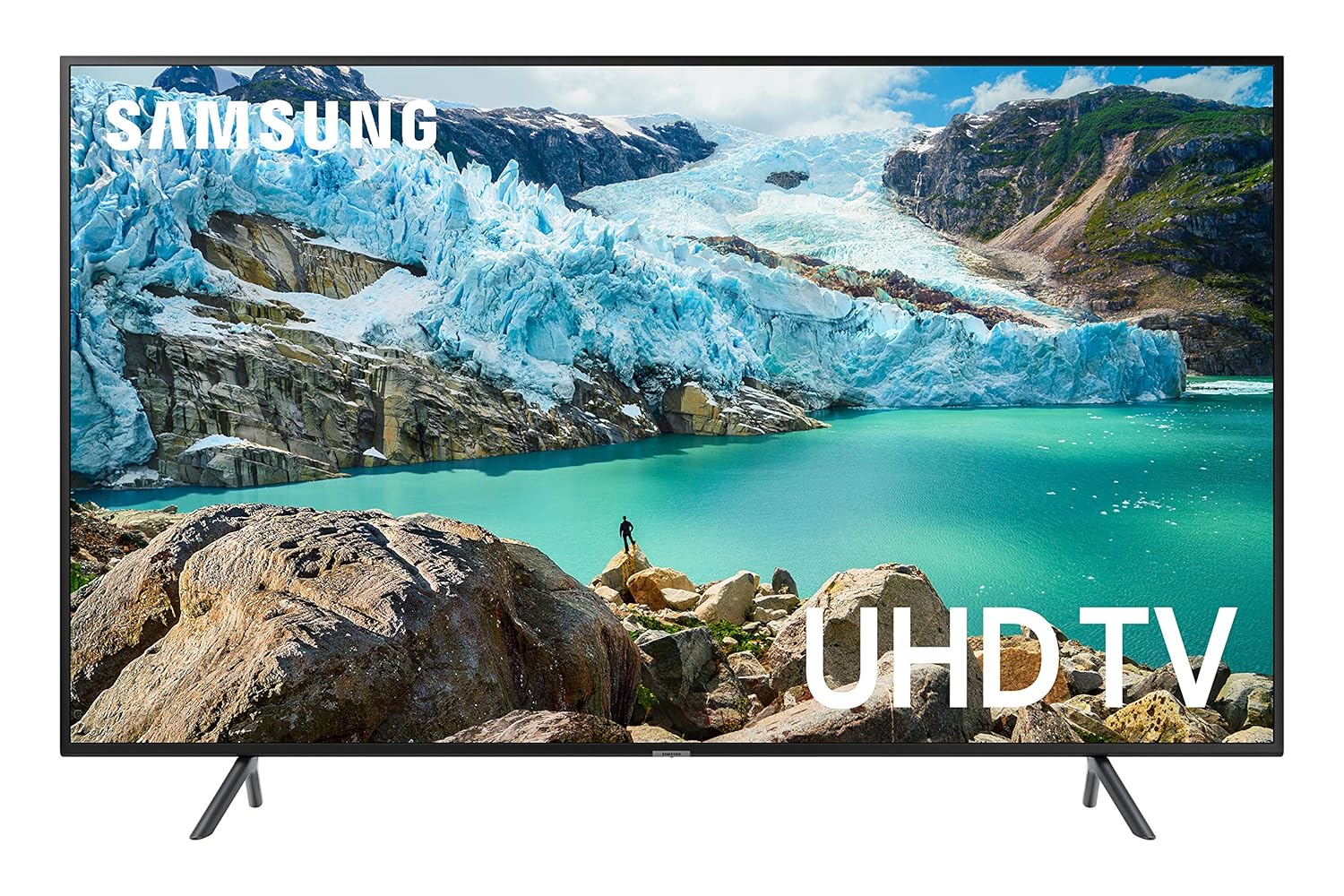
Samsung Consumer Displays v Samsung Commercial Displays
I’m looking at to displays that were made at about the same time. Both are made by Samsung; one is a consumer display and the other is a commercial display. Getting the differences between them has required my own exploration and experimentation. Samsung has a site at https://samsungDforum.com that contains information about the consumer displays. Unfortunately this information is only available to those that sign up for the Samsung Partner program. From what I’ve read about this program an NDA is required to enroll within it. I have not signed up for this program; if I did then I wouldn’t be able to talk about the information gained within it. As part of my interest in the displays is to talk about them (on this blog) I’m instead am gathering information both from experimenting with the display and through scraps of information available on the Internet.
The process of experimentation has had it’s moments of frustration, and I’ve already written some material on my experiences that are to be posted in the future. In my next post on this topic I’ll talk about the differences in the Samsung Consumer and Commercial displays.
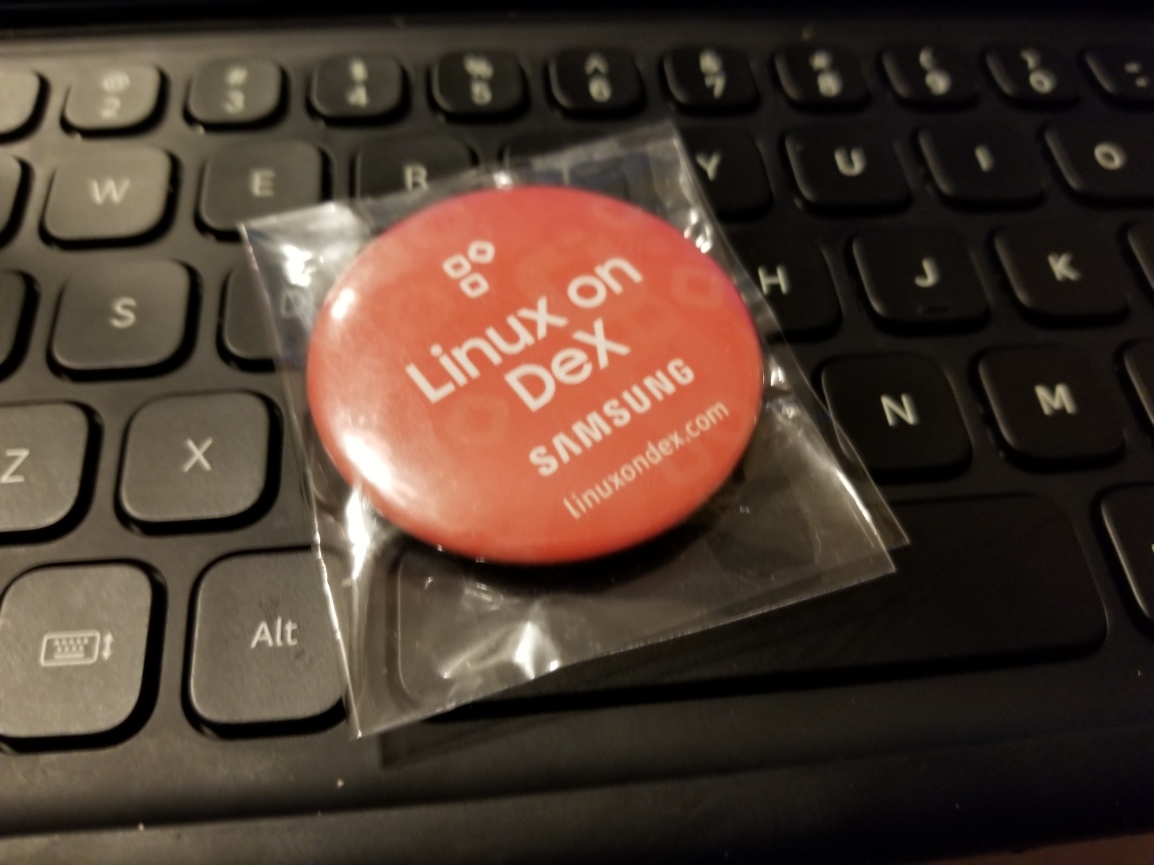
Unfortunately, Samsung has recently announced the end of Linux on Dex support. The last time I mentioned LoD was when Samsung mentioned it was coming to more devices. A close associate recently acquired one of those devices to which support was coming. When I tried to get her sign up for the Beta I had found that there was no way to get her signed up. That was about two weeks before the Samsung announcement.
To summarize, Samsung stated what as one upgrades to Android 10 they would loose the Linux on DeX functionality; if someone wants to run a full Linux setup on their computer they will have to avoid upgrading. There was no statement on whether or not there will be anything to replace this functionality.
Personally I will miss this functionality. When I was finally able to access it I was able to leave my computer behind when I went on trips. While it wasn’t as fully ccapable as my laptop it supported enough functionality to be a secondary developerment solution; I could do enough things to respond to some unanticipated requests. I had access to GIT, Node, and various other development and command line tools include Visual Studio Code. Unless Google or Samsung plan to release a replacement this will be functionality lost with the next OS update.
In the mean time I’ll be looking back to the Chromebook. The Chromebook has some limited linux support that may be helpful. Though the last time I used it there was no where near as much functionality as LoD.
The objective of this entry while basic covers an easy mistake to make. It is a mistake that I have made. I’ve got a new Samsung Series 6 TV and I tried to deploy a new project to it. Errors were encountered, frustration levels were raised, but eventually I encountered success.
The Samsung TVs are more locked down than some of the other Tizen devices that I’ve worked with. The more recent ones are more locked down than some of the previous ones. When things go wrong this is what you might see.
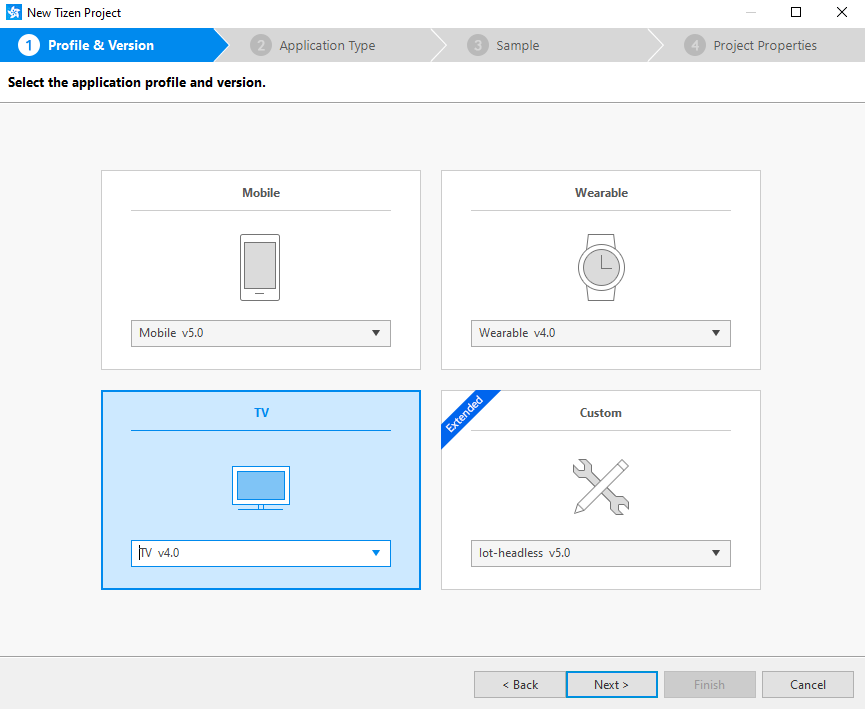
The TV I am using runs version 4 of the Tizen operating system. I make a new Tizen project and select to create the new project from the TV templates choosing Tizen 4 as the platform.
Attempts to debug the project created from this template fail. I get an error message stating:
Launching [your app name here] has encountered a problem
closed
   closed
     closed
The terminal output isn’t of much help.
Launching the Tizen application...
# If you want to see the detailed information,
# please set the logging level to DEBUG in Preferences and check the log file in 'C:\tizen-studio-data\ide\logs/ide-20191006_014055.log'.

[Initializing the launch environment...]
RDS: Off
Target information: UN43NU6900
Application information: Id(07DOxO8iKR.SystemInfo3), Package Name(07DOxO8iKR), Project Name([your app name here])
Unexpected stop progress...
(0.337 sec)
So what gives? There are two ways to address this that are essentially two paths to the same destination. The manual solution involves editing a couple of configuration options in the files config.xml and .tproject.
The file .tproject is not visible in the Tizen IDE. But you can still open it through file -> open. This file is an XML file. There is an element named that has a sub-element . I changed the value here to tv-samsung-540. The other change in config.xml is on an element of the form . This needs to be changed to .
Why are these changes necessary? I don’t have full confirmation on this, but I believe it has to do with differences between a generic Tizen device and Samsung Tizen devices. At the time of this writing I know of no physical implementations of any non-Samsung TV Tizen devices. But it does exist as a specification.
The other solution would be performed at the creation of the project. When creating a new project do not select from the TV project templates. Instead select the Custom project templates. Within these templates there is a TV template subtype. If you choose this project type then you will start off with the configuration files mentioned above having the values that are needed.
As the Tizen operating system and the development environment are updated year to year more readers will read this entry after a new Tizen version has been released than before. It is likely that the exact values that you include here will be different than what I have used. You may need to update the values accordingly. But hopefully this will point you in the right direction.
If you try to install Windows 10 IoT core from the installer chances are you wil get blocked with the following error.
Your administrator has blocked this application because it potentially poses
a security risk to your computer."  and "Your security settings do not allow
this application to be installed on your computer.
I ran into this recently when preparing a Raspberry Pi to run Windows 10 IoT Core. What gives? Well, that is due to a Windows Security Setting. The setting can be changed by editing the registry. The registry key can be found at the following location
The keys inside of this path contain one key named Internet that is set to Disabled. Change it to Enabled. Then you should be able to perform the installation and then change the key back.
Raspberry Pi Starter Kit
Available on Amazon for free at the time of this writing
The holiday season is upon us; by the end of this month I expect to start seeing my neighbors put out their fall decorations. By mid-October decorations for Halloween will show up. After Halloween the decorations roll back to fall themed only and then are changed to Christmas decorations right after new years. Two of these holidays tend to come with flashy displays and lights: Halloween and Christmas.
I primarily use Phillips Hue lighting throughout my house and it is a perfect companion for festive displays. The color bulbs are adaptable to any color scheme and the newly released Edison-style bulbs add a warm glow to fall scenes. The Phillips Hue lighting sets are programmable if you are using a hub. While the new light bulbs have Bluetooth support to directly be controlled by a phone there’s not public API for them (yet). For programming a hub is needed.
I’ve written on controlling the Phillips Hue lights before. Expanding on that I wanted to make a project that would let an IoT device trigger a scene according to some external event. I’ll use a motion sensor to trigger the relevant events.
But you could also use sound, change in temperature, lighting, or time as sources. I’ll be using a Raspberry Pi; it has network connectivity and can be easily interfaced to a number of devices. I’m using the Raspberry Pi zero but about any Pi will do. Hue does have available a motion sensor ; if one only wishes to control lights based on motion a solution is available. But if one wishes to have other triggers or trigger other actions along with the lights a custom solution is needed.
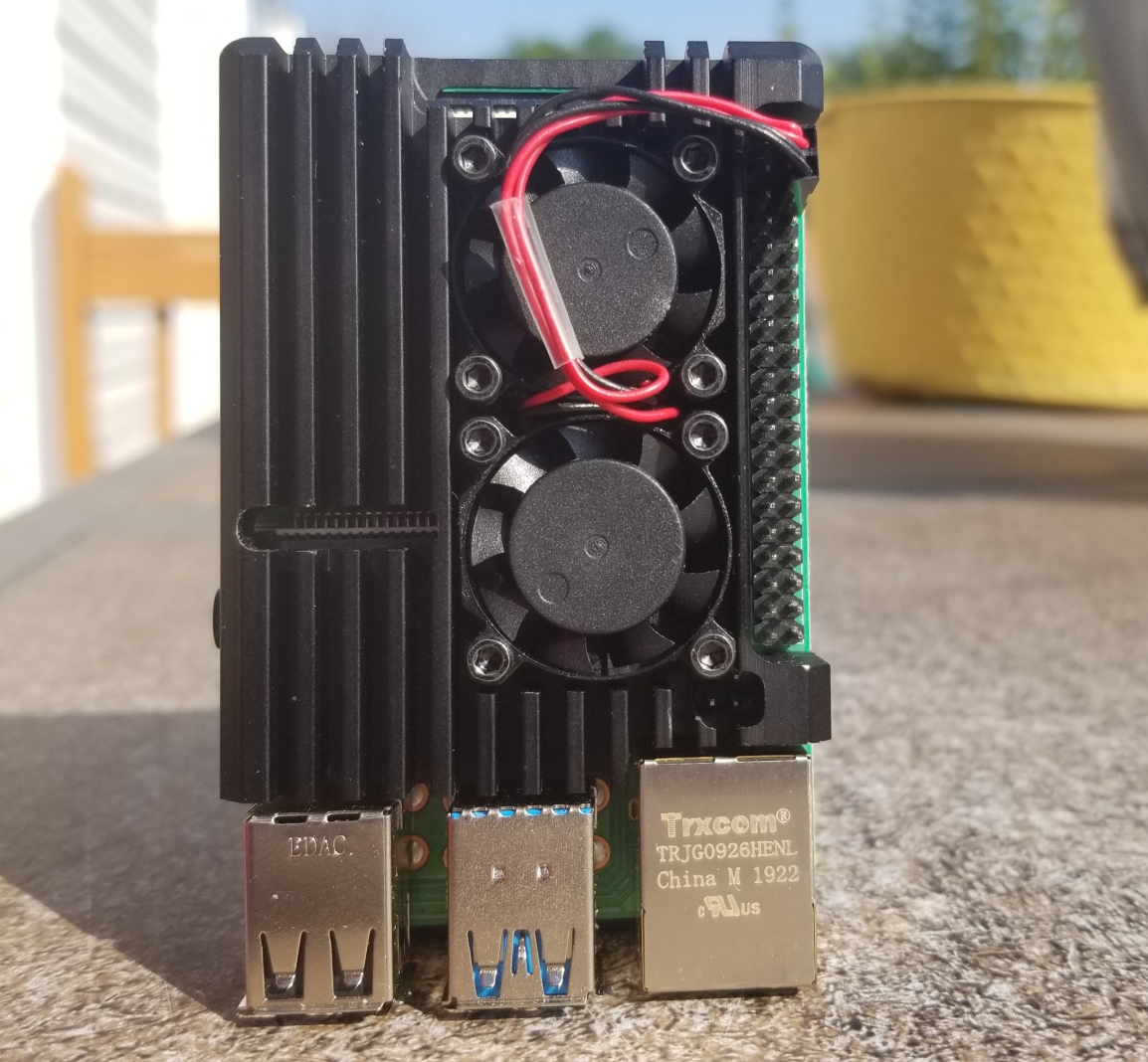
The Raspberry Pi 4 with a heat sink attached.
Raspberry Pi Zero with a 4-port USB hub
All that I want to happen is for the the lighting pattern to change when a person is detected. I’ll use a passive infrared sensor for presence detection. For Halloween I want a Hue light that is illuminating a jack-o-lantern to pulsate an orange color. When someone comes up knock on the door I want the light for the front door to go bright white. A few moments after a person is no longer there I want the system to go back to it’s previous pattern. But past a certain hour I don’t want this to continue; after 10:00pm the lights should extinguish. Simple enough, right?
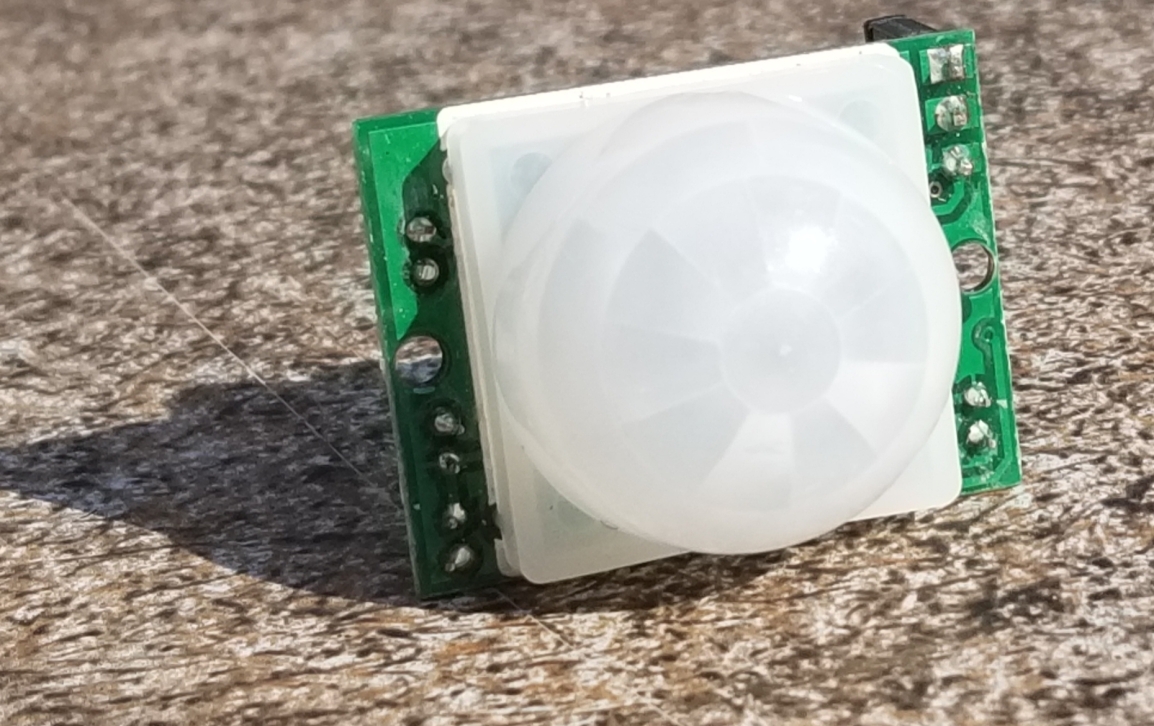
This is the passive infrared sensor that I used.
The physical build for this circuit is easy. The Passive Infrared Sensor (PIR) will get power from the VCC and ground pins of the Raspberry Pi. The signal line from the PIR can be connected to any of the GPIO pins. I’m going to use pin 3. The circuit will need to be put in an enclosure to protect it from rain or humidity in general. If your enclosure doesn’t already have a weather protected way to get power in your options are to either run the Pi off of a battery that is within the enclosure (that means periodic recharging) or drill a hole for the wires yourself and apply a sealant.
There are a lot of languages that I could use for writing my program on the Pi. Python, Java, and C/C++ make the top of the list (in no specific order). For this project I’ve decided to go with Java. To interact with the pins in Java we will need to import classes from com.pi4j.io and com.pi4j.wiringpi. These are not standard libraries; they exists to provide an interface to the pins. To demonstrate reading a pin in Java here is a simple program that will print text in a look that reflects the pin state.
import com.pi4j.io.*;
import com.pi4j.wiringpi.Gpio;
import com.pi4j.wiringpi.GpioUtil;

public class PinTest {
   public static void main(String args[]) throws InterruptedException {
      final GpioController gpio = GpioFactory.getInstance();
      Gpio.pinMode (3, Gpio.INPUT) ;
      while(true) {
         if (Gpio.digitalRead(3) == 0){
               System.out.println(The Pin is ON");
         }else{
            System.out.println("The Pin is OFF");
         }
      }
   }
}
Phillips has an SDK for Java. You might see it present as an SDK for Android, but it works fine in other Java environments. A convenience from this is that a significant portion of the development can be done on your computer of choice. I did most of the development on a Mac and used git to transfer it to the Raspberry Pi when done.
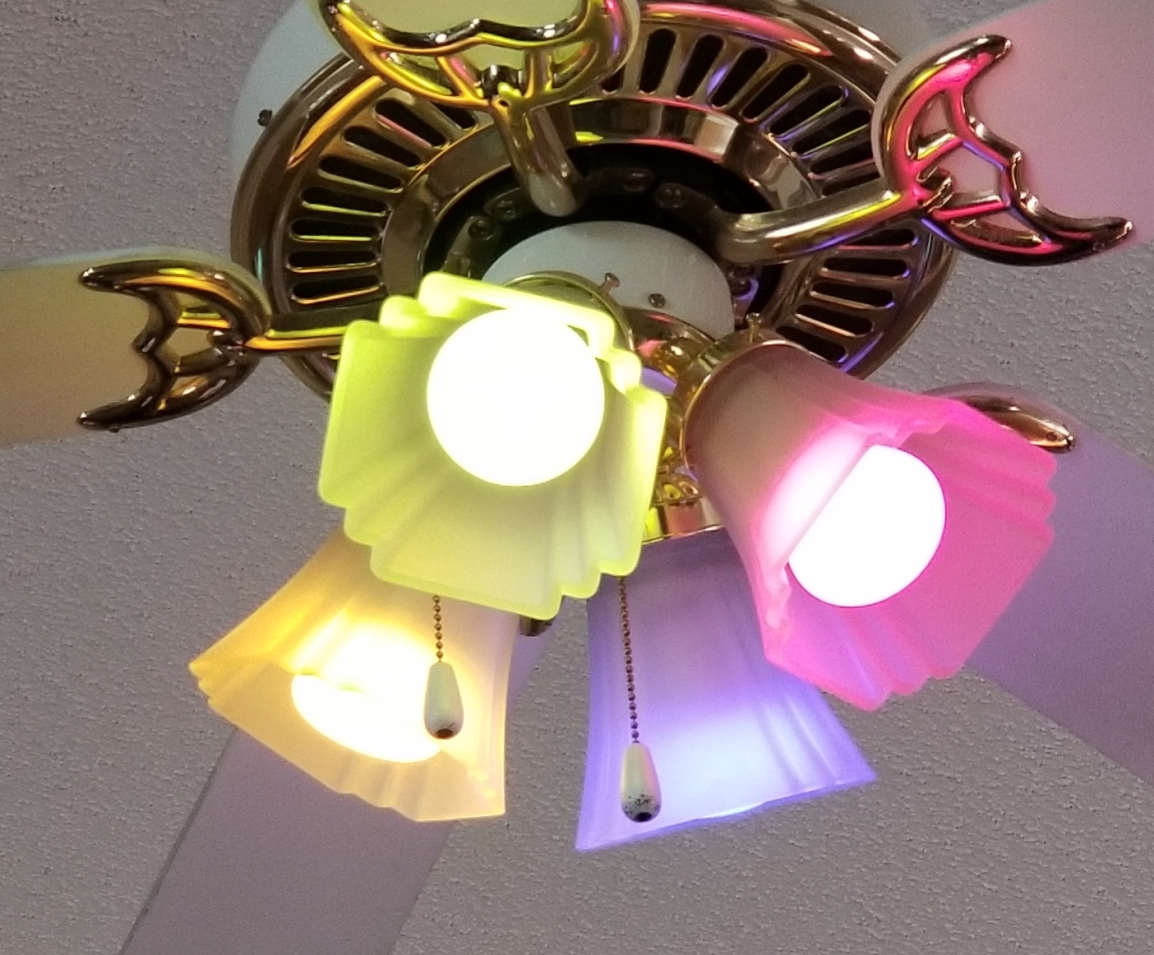
The color Hue lighting can take on a variety of colors.
The overall execution loop of the program will check whether or not the trigger condition has occurred. If the trigger condition has occurred then the program will activate a scene. If not then it deactivates the scene. The program loop also contains some debouncing logic. Depending on the type of sensor used and the sensors characteristics a sensor could change states with ever cycle. I’ve chosen to only deactivate if a certain amount of time has passed since the last activation. For initial development instead of interfacing to an actual sensor I have a method that is returning a random Boolean value. When the code is moved to the Raspberry Pi this method will be updated to read the state of the actual sensor. The following will only deactivate after there have been 2 seconds with no activation event.
Controlling the lights happens through the Hue SDK. Before activating the lights the Hue bridge must be discovered. While Hue makes a series of lights that have Bluetooth controllers built in and can be controlled without the Hue Bridge currently they only support APIs through the bridge. It is a required hardware component.
The SDK already contains functions for discovering the bridge. All that a developer needs to do is initiate a search and implement a callback object that will receive information on the bridges discovered. In the following I instantiate the Phillips Hue SDK object and register a listener. If the program had been connected with a bridge before the IP address if that bridge is loaded and it reconnects to it. Otherwise the search is initiated. As the search occurs the earlier registered listener receives callbacks.
private void init() {
    this.loadSettings();
    System.out.println("Getting SDK instance");
    phHueSDK = PHHueSDK.create();
    System.out.println("Setting App Name");
    phHueSDK.setAppName("HolidayLights");
    phHueSDK.setDeviceName("RaspPi");
    System.out.println("SDK initialized");
    phHueSDK.getNotificationManager().registerSDKListener(listener);

    if(this.getLastIpAddress()  != null) {
        System.out.println("Connect to last access point");
        PHAccessPoint lastAccessPoint = new PHAccessPoint();
        lastAccessPoint.setIpAddress(getLastIpAddress());
        lastAccessPoint.setUsername(getUserName());
        if (!phHueSDK.isAccessPointConnected(lastAccessPoint)) {
            phHueSDK.connect(lastAccessPoint);
        }
    } else {
        System.out.println("Searching for access point");
        PHBridgeSearchManager sm = (PHBridgeSearchManager) phHueSDK.getSDKService(PHHueSDK.SEARCH_BRIDGE);
        // Start the UPNP Searching of local bridges.
        sm.search(true, true);
    }
}
The listener is of type PHSDKListener. I won’t show the full implementation here but will show some of the more relevant parts.
When the bridges are found they are returned as a list. I’ve only got one on my home network and so I connect to the first one seen. If you have more than one bridge you’ll need to implement your own logic for making a selection.
@Override
public void onAccessPointsFound(List accessPoint) {
    System.out.println("Access point found");
    if (accessPoint != null && accessPoint.size() > 0) {
        System.out.println("Number of access points: "+new Integer(accessPoint.size()).toString());
        phHueSDK.getAccessPointsFound().clear();
        phHueSDK.getAccessPointsFound().addAll(accessPoint);
        phHueSDK.connect(accessPoint.get(0));
    }
}
When the connect attempt is made it is necessary to press the pairing button on the bridge. The console will print a message from the SDK saying this. Once the bridge is connected I save an instance of the bridge and the a
After the bridge connects the SDK will query the state of the lights on the system and update some objects representing the last known state of each light. The first time the cache is updated the program prints the name of each light and the light’s identity. This information is useful for selecting which lights will be controlled. The light list is saved for the program to use.
With that in place we now have enough information to change the state of the lights. To test things out I started with implementations of activateScene and deactivateScene that will just turn all the Hue lights on and off (don’t do this if you have other people in your dwelling that this would affect).
If the program is run at this point the lights will turn on and off somewhat randomly. Ultimately we don’t want it to control all the lights. Instead I want to be able to specify the lights that it is going to control. I’ve made a JSON file file that contains a couple of elements. One is the RGB color that I want to use in the form of an integer, the other is an array of numbers where each number is an ID for the light to be controlled. The RGB color is specified here as a base 10 number instead of the normal base 16 that you may see used for RGB codes. Unfortunately JSON doesn’t support hexadecimal numbers 🙁.
{
    "lights":[5, 7, 9],
    "color": 16711935
}
These values are read by the code. Before the code acts on any light it checks to see if its identifier is in this array before continuing. During activation if the identifier is in the array the light’s state is set to on, brightness is set to full, and the color is applied. The color must be converted to the right color space before being applied to the light; something that is done with a utility function that the SDK provides.
The last steps needed to make the device work as intended are to update the getActivationState() function to read the actual state of the motion sensor instead of a random value and wiring the motion sensor to a Raspberry Pi. From hereon the code is only going to work on a Raspberry Pi since the libraries for reading the pins are only applicable to this device. It is possible to dynamically load class libraries and use them as needed for the specific platform on which code is running. But information on doing that is beyond the scope of what I wish to discuss here.
I’m declaring a GpioController variable at the class level and am instantiating it in the constructor. I also set the mode of the IO pin that I’ll be using to input.
With that change it will now work. If the Raspberry Pi is placed in a position where the motion sensor has a view of the space of interest then it will control the lights. If you are using one of the earlier Raspberry Pis (anything before the Raspberry Pi 4) you should be able to also power the Pi off of a portable phone charger; there are many that will make sufficient batteries for the Pi. The Raspberry Pi 4 has higher energy requirements and you may run into more challenges finding a portable power supply that works.
Why use the Pi at all for this? Because there is a lot of room to expand. Such as using the video capabilities of the pi to power a display or controlling other devices. Controlling the lights is a start. I’ll be revisiting this project for add-ons in the future.
If you want to start on something similar yourself the following (affiliate) links will take you to the products on Amazon.
If you already have a Samsung TV and want to start developing for it chances are you don’t have the latest and greatest model. But when you install the Tizen development tools they only target 2 operating system versions; the latest version that is out now and the version that is yet to be released in a year or so. Your TV is too old! So what can you do?
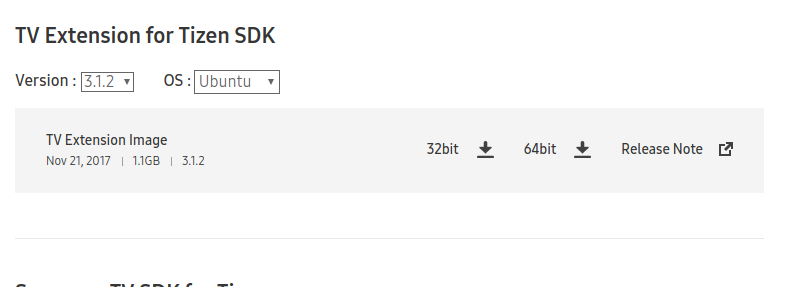
If you check the Tizen development forums the suggestion is to install an older version of the development tools. But that’s no fun! And it is possible to develop for the older TVs with the newer tools. Go ahead and install the latest versions of the Tizen development Studio first. While that is installing you will need to download an older version of the Extensions for TV. You can find them at this site. As you scroll through the available versions you will see that if you attempt to get a version older than the 3.0 version you can’t download it. Download the 3.1 or 4.0 extensions. Don’t worry, the extensions also contain the components needed for TV’s running the 2.3 and 2.4 Tizen version.
After Tizen Development Studio is installed open the package manager. In the upper right corner of the package manager is a gear icon. Select it.
Expand the “Extensions SDK” area of the window to see the extensions installed and click on the + button to add an extension. A window opens asking for a URL. Leave the URL blank and click on the three dots next to it. You’ll now be asked to navigate to a local archive of the extension you with to add. Navigate to the file that you downloaded earlier and select it. The package manager will take a few moments to install the extension.
When you attempt to create a new project and look at the TV templates available there’s only the 4.0 and 5.0 projects. What gives? The missing project templates can be found under the Custom projects. Select “TV-Samsung v3.0.” Even if you have a TV running Tizen 2.3 this opeion will work. When you click the next button you’ll see the familiar project templates.
In a Tizen project I was working on I found that Tizen Web alone wasn’t enough to help me accomplish my goal. For some of the functionality that I needed a native application would be needed (more on that in another blog post). Rather than completely write the application in native code I was going to use HTML for the UI and a native service for other functionality. This is a Tizen Hybrid application.
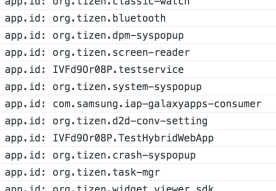
The Tizen documentation wasn’t quite clear to me on what identifier to use when trying to launch a service packaged with an HTML application. It mentions using the App ID. This didn’t work for me. I only figured out the right name to use when I tried listing all of the applications and services on the device.
Getting a list of the applications and services is done through tizen.application.getAppsInfo. This function takes as a parameter a callback. The call back is given a list of the applications installed on the device. For my purposes I was only interested in the id member of the objects that were passed back.
tizen.application.getAppsInfo(
    function onListInstalledApps(applications) {
        console.log("List of Applications:");
        applications.forEach(
          function(app) {
    		console.log(`  app.id: ${app.id}`);
        });
    });
Once I saw the output of this it was easy to identify the problem I encountered with launching the service.
Output of app listing code
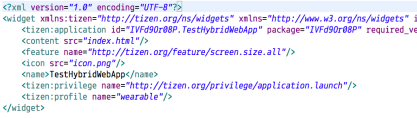
According to the Tizen documentation when launching a service the ID string used is composed of the package ID and the app ID of the service. The package ID can be found in the confix.xml for the web application. In the following you can see the package ID is “IVFd9Or08P”.
The app ID can be found in then tizen-manifest.xml for the service project.
The app ID here is “org.sample.service.” If you look in the output from the code sample for listing installed applications you will see that the service shows up as IVFd9Or08P.testservice. It is using the entry from the “exec” field instead of the appid field. I’m not sure why the documentation points to the appid only. But I’m happy to have figured out this problem.
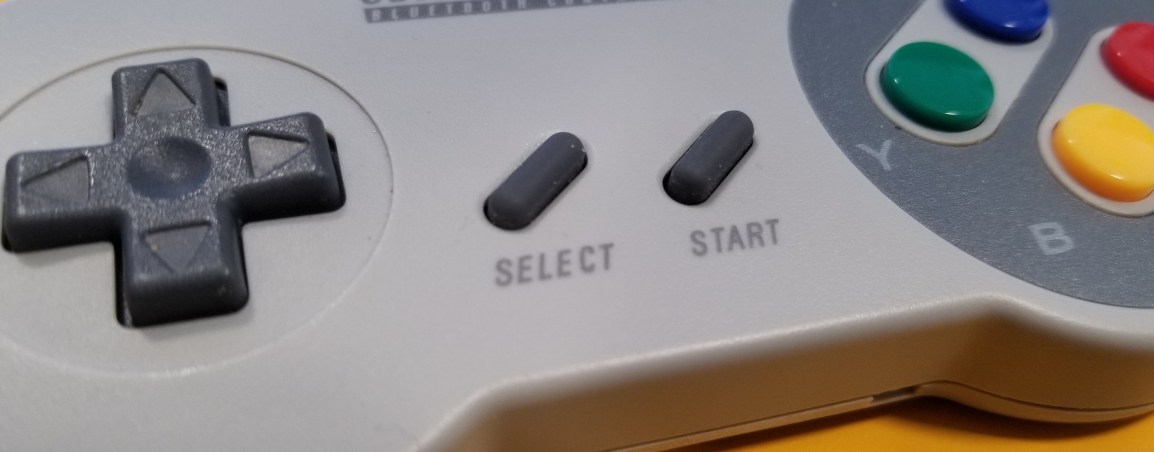
I was thinking about a video game from my childhood and how easy it would be to rebuild the game now. Having decided to do this I had to decide what platform to target. I chose to make it a browser application. While the game could be played with a keyboard or mouse I wanted to use a game pad to play it the way it was meant to be played.
Game pads can be used in HTML. I’ve not seen many applications that actually take advantage of this, but as game streaming becomes more popular this is likely to change. Let’s start with one of the simplest things we can do: detect what game pads are present. I’m going to share all of my code in TypeScript. TypeScript is basically JavaScript with type information added. It compiles down to JavaScript. The advantage of using it here is that you will know the data types of a variable or parameter instead of needing to analyze the code and make inferences.
Detecting a Game Pad
To start we want to ensure that our browser supports the game pad API. To do this just check whether or not the getGamepads function exist on the navigator object.
var isGamepadSupported:boolean = (navigator.getGamepads != null);
There are two ways that we can detect the presence of game pads. We can listen for the events that are fired when a controller is connected or disconnected, or we can just poll for their presence. Here’s a code sample that does just that. The TypeScript elements are highlighted in blue.
function handleGamePadConnected(e:GamepadEvent) {
     console.log('A game pad was connected', e);
}
function handleGamePadDisconnected(e:GamepadEvent) {
     console.log('A game pad was disconnected', e);
}
window.addEventListener("gamepadconnected", handleGamePadConnected);
window.addEventListener("gamepaddisconnected", handleGamePadDisconnected);
If we run this code within a page we can see the code get triggered by ensuring the browser has focus (a browser without focus will not receive game pad events). Connecting and disconnecting a controller (if USB) or turning a controller on and off (for Bluetooth) will cause the event to trigger. On some controllers you may have to press a button for it to fully connect. The event passed to the handlers has a field named game pad that contains all of the data for the game pad being used. The other way to get this information is to try to read the game pad state Calling navigator.getGamepads() will return information on all the game pads connected to the system. A word of warning though, the value returned is an array that has some null elements in it. If you iterate through the array don’t assume that because you are reading a valid index that there is actually an object there.
This might sound weird at first, but imagine you are playing a four player game and player 2 decides to turn off his controller and leave. Rather than assign a new index to players 3 and 4 their controller indices will stay the same and the second element in the array will be null. To get the state of all of the game pads attached to the system use the following.
var controllerStates:Array<Gamepad> = navigator.getGamepads();
When I call this method I always receive an array with up to 4 elements in it, most of which are null. If this function is being called in the game loop from one call to another one can see what controllers are present . Keep in mind that the object returned here is the state of the game pad, but it is not a reference to the game pad itself. If you hold onto the object it will not update as the state of the controller changes.
There are two properties on the GamePad object of most interest to us; the buttons property has the state of the buttons and the axes property contains the state of each axis for each directional control on the game pad.
Axes
A D-pad input on a controller has two axes that can range from -1 to 1. There will be a vertical axis with three possible values and a horizontal axis with three possible values. While one might expect the neutral position of the controller to be zero I’ve found that even with my digital controllers the neutral value is near-zero but not quite zero. There is a range for which we could receive a non-zero value that we would need to treat as zero.
For the analog sticks the general range of values returned will also be between -1 and 1 for each axis, but there are values between this range that could also be returned depending on how far the directional stick has been used. When the stick isn’t being touched the axis will return a value that is near zero. Like the digital input there is a near zero range that should be treated as zero. Note that the controller interface may return more axes than actually exists on the controller.
Buttons
The buttons element of a GamePad object has a list of buttons. The collection may return more objects than there are physical buttons on the controller; these non-existing buttons will not change state. The GameButton Interface has three attributes.
pressed – will be true if the button is pressed, false otherwise.
touched – for controllers that can detect touch this attribute will be true if the button is touched, false otherwise
value – a value between 0 and 1 that tells how far the button is pressed or how hard it is pressed.
Even if you have a controller that doesn’t support touch or analog input the touched and values buttons will still update. If a button is pressed it can be inferred that it is being touched and the touched attribute updates accordingly. For a digital button the value attribute will only be 0 or 1 and no value between.
There are some other attributes that can be found on the game pad that I haven’t discussed here. There GamePad object has an index attribute that will identify its own index in the array. There is a string id field that gives a name identifying the controller. There is also a timestamp attribute that indicates the time at which a Gamepad object was grabbed.
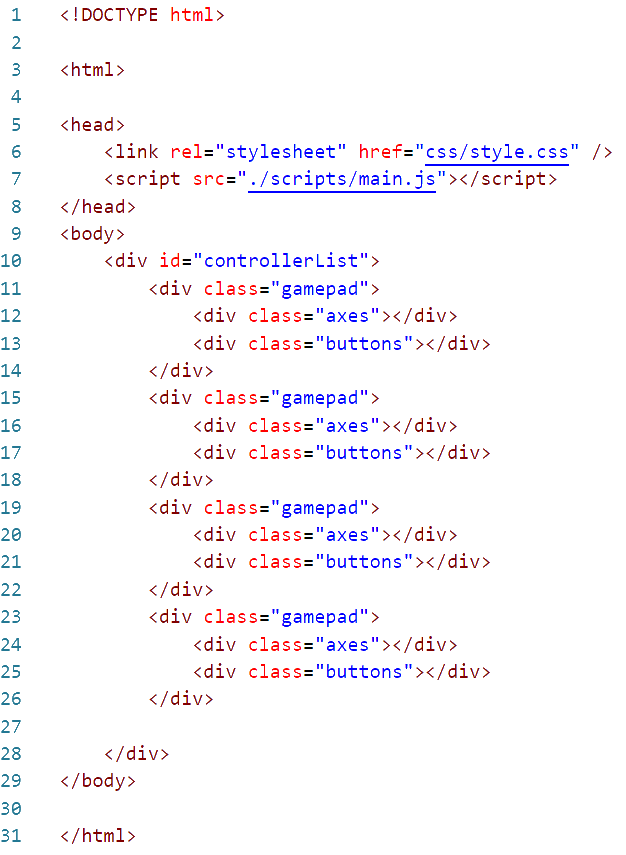
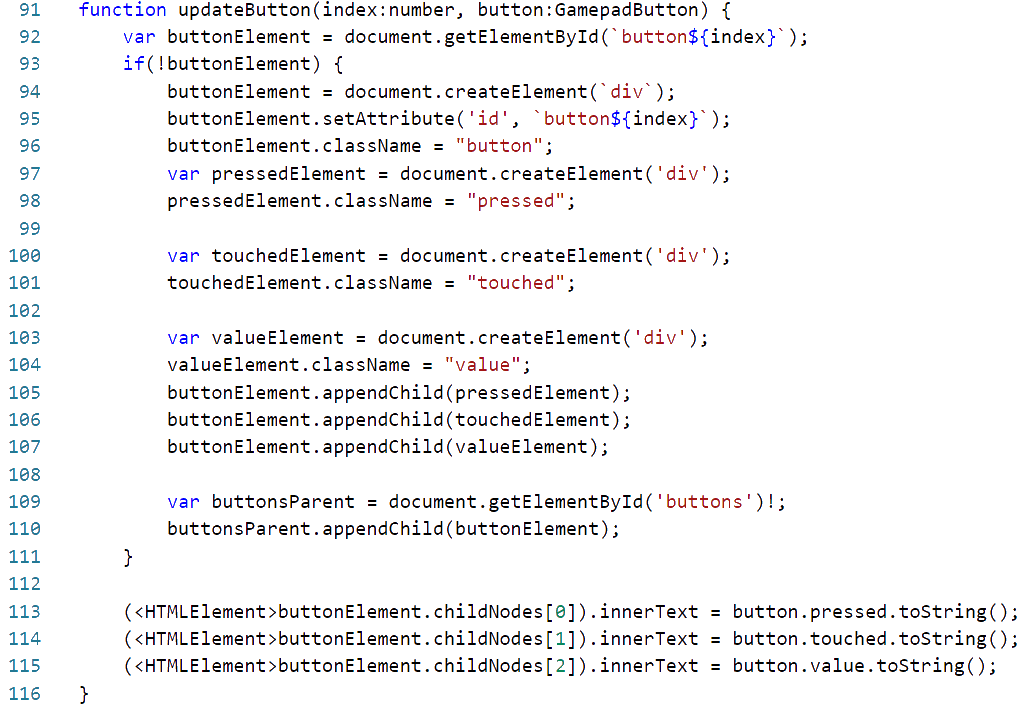
This code sample here will read the states of up to 4 controllers and show their states on the screen. I’m using images to present the code here as I have found that WordPress will sometimes unescape HTML code and render it as HTML instead of text. But you download the code sample directly to view it.
The file main.js here was compiled from a typescript file, main.ts. Execution in mail.ts starts after the document is loaded. The first method executed is named start. It adds some handlers for the game pad being connected or disconnected. These handlers only print the event out to the console. We are more interested in what is running within the interval. In the interval the states of all of the game pads is retrieved and then we call a function (updateController) to display them on the screen.
Update Controller will find the HTML block to which a specific controller index is assigned and get the represented button state and axes states updated. The functions updateAxes and updateButtons take care of the details of these. There are several other HTML elements needed for this that were not declared in the page. Instead they are being created as they are needed.
In updateAxes if the needed element doesn’t exists I create it and then I show the value of the axis.
The function updateButtons does pretty much the same thing. Only instead of a single element it is updating three.
Do you have a game controller and want to try things out? I’ve got it loaded on a web page that you can try. Get your computer and controller paired. Then see the demo run at https://j2i.net/apps/gamePadStatus/
I recently was working on a project in which, among other things, there needed to be a process that would restart the application should it ever be terminated for no reason. This isn’t unusual for kiosk applications where the only UI that the user will be able to get to is a single application running on the system. This isn’t an unusual need and something for which we had a utility that could do this; we generally refer to these as “Kiosk Application Monitors.” But I decided not to use it. Why not? Because when developing it is a pain to deal with an app that isn’t easily killed. If I manually terminated the application it would almost immediately restart; this was a behaviour that was by design. When I really wanted the application to terminate and stay that way things were more challenging. This had to be done from the task manager and the task manager wasn’t easily accessible since the KIOSK app ran as always on top. To see the task manager I would first have to kill the app. But if the app were killed it would just restart.
Not wanting to deal with the difficulty of this I made a new a Kiosk Application Monitor (hereon referred to as KAM). While I would generally prefer to make utilities in C# I used C for this; I was going to be using Win32 APIs and it is easier to have direct access to them instead of writing P/Invoking declarations for them.
The key difference in this KAM and the other ones that we had used was that this KAM could be terminated through keystrokes. It adds a keyboard hook that receives every keystroke that a user makes no matter what application.
Termination on Detecting Safe Word
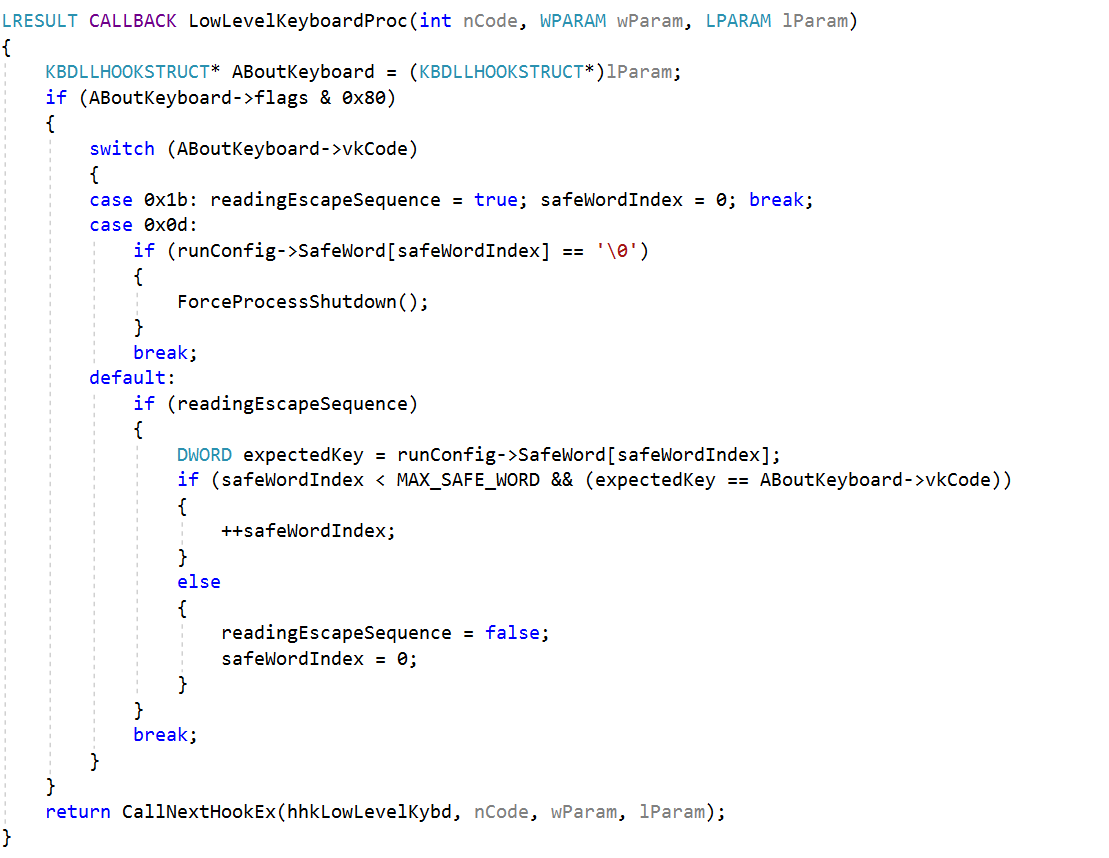
I’ve got a variable named SafeWord that contains the word that when typed will kill all of the child processes and shut down the KAM. To better insulate the app from an accidental activation I’ve mandated that the escape key be pressed before the safe word and the enter key be pressed immediately after the safe word. The keyboard hook receives the virtual key codes for the keys pressed. The code for escape (0x1b) and enter (0x0d) are both used directly within the source code. Any other key press will be will be ignored until the escape key has been pressed, and will be checked for a match to the safe word. At the first mismatch the procedure will stop comparing until the escape key is pressed again. When the enter key is pressed the routine checks if the end of the safe word has been reached. If it has then the user has typed the same word; the routine to terminate the child processes is called.
They keyboard routine is a small part in what this does, but a real time saver for me.
Allowing Only One Instance
I didn’t want more than one instance of this program ever running on the same machine. The way I managed that is pretty usual for Win32 programs; I used a named event to ensure there is a single instance. Named events are shared across programs. After creating one (with CreateEvent ) calling the GetLastError() function afterwords indicates whether or not this is the only instance of an application that has access to the event or if another program already has an instance of an event by the same name. When another instance has already created one GetLastError returns ERROR_ALREADY_EXISTS.
Process Description and Start-Up
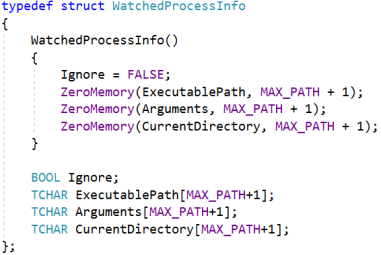
Moving from the ancillary functionality to the core functionality, I decided to use JSON for specifying information on the processes that should be started and watched. The C++ libraries do no intrinsically support JSON data handling. I used a third party library for this. The data in the JSON is used to populate a structure that gives very basic information on the process to be monitored.
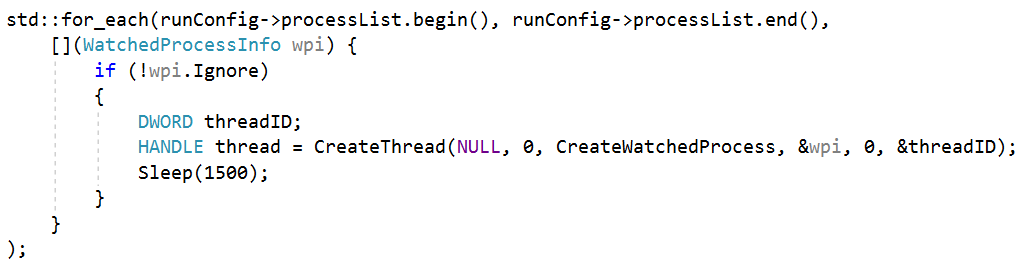
Most of these values are passed directly to the Win32 function CreateFunction. Ignore is there so that I could disable a process without completely removing it from my configuration file. For each process that I’m going to start I create a new thread to monitor it.
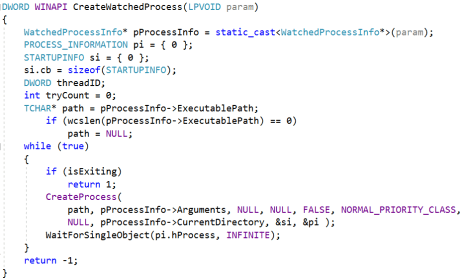
Most of the code within the CreateWatchedProcess function will run within an infinite loop. The process is created and information about it is populated into a PROCESS_INFORMATION variable (which I have named pi). The value of interest for the KAM is pi.hProcess. This is the process handle. The wait functions in the Win32 API can accept handles processes. In the case of WaitForSingleObject passing a process handle will block the calling thread until the process terminates. There is nothing that my program has to do for detecting the termination of the process. When the next line after WaitForSingleObject executes we know the process has been terminated. The only question is if it was terminated because there was a request for the KAM to shut down or if this were an unexpected .
How Did it Perform
In testing things worked fine. I’d intentionally put a bug in the program of interest that would cause it to crash and the KAM restarted it. The app I was using it with also remembered it’s state and could restore the UI to what it was before. From the perspective of the user the screen flashed but was otherwise normal. When I tried the same utility in the production environment I’m happy to say that its full functionality was not exercised; the program it was monitoring never crashed.
I’ve found the program to be useful and see some opportunities to increase it’s utility. I plan to make updates to it to support things such as starting processes in a specific order, monitoring the message pump of another process to detect lock conditions, and allowing the utility to accept or transmit process information over a network connection.
It’s 10:39 AM on January 4th, 2019 as I sit and begin typing this in the Buckhead area of Atlanta. Around the world, if other people were to read that (with appropriate language translations applied), there would be an overwhelming agreement as to how long ago that was. Such an agreement wasn’t always the case throughout human history. Throughout time humans kept different calendars and clocks in different civilizations. It hasn’t always been possible to take a statement like my first sentence and reach the same consensus on it that we do today.
My thoughts in this article are reflecting on the changes in time keeping methods throughout history and how they differ. They are related to a simple question that someone asked me: how do I know what time the sun will set. There are some other astronomy related programs that I plan to discuss in the future and will be referring back to this post when expanded information is needed on a topic.
Solar Days
Across human cultures, one concept of time measurement is derived from the apparent movement of the sun. This is a frequent and common celestial observation that is shared among humanity in most areas on the earth that are populated. Most of us regularly see the sun appear to rise above the horizon in one area of the sky and go back below the horizon in another. At areas close to the polar regions, depending on the time of the year, the sun might not go below the horizon, but instead travels in a circle around the observer (circumpolar movement). The same areas at other times of the year might not see the sun, but they still have the experience of being able to make the celestial observation.
From this observation humans have created the concepts of the day and the night and can communicate about past and future events in terms of the number of instances of this observation. The first division of this period is the instance in which the sun is above the horizon and the times in which it is below the horizon (day and night) and the instances at which it is making this transition (sunset, sunrise). There is also the instance at which the sun is at its apparent highest point in the sky; solar noon.
Hours
In East Asia a day was divided into 24 periods. During one of these divisions the starts of the night sky appear to move about the pole by 15 degrees. (Note: you can use the word “hour” to talk about 15-degree increments absent the concept of time). An even finer division of these periods is thought to have come from the Sumerians through the Babylonians. They had a counting system that instead of being base-10 was base-60. The Sexigesimal.
Mean Solar Day
If you measure the passage of time from one sun rise to another you’ll find that it isn’t the same every day and wobbles throughout the year. This is in part from the earth’s orbit around the sun being eliptical instead of circular and part from the 23 degree tilt of the earth with respect to it’s orbit around the sun. The longest period between sunrises is experienced about December 21 or December 22 (the winter solstice) and the shortest is at the summer solstice about June 20. As it turns out the apparent movement of the sun isn’t a great way by itself to keep track of time. But we can take the average (mean) of the length of these periods over a year and use that as a measurement of time. This is the time that our watches and other time pieces are based on; the mean solar day.
Sidereal Day
Celestial Sphere
Relative to each other the stars appear to not move. From one night to another they appear to be in fixed positions rotating around the earth. This is sometimes visualized as a rotating sphere on which lights are fixed known as the celestial sphere.
Solar observations are not consistent from day to day, but observations of the stars over a considerable period of time are consistent. your face towards the sun at noon on one day and then turned your face to the sun at noon at another day (let’s say 180 days later) you would not be facing in the same direction. If you turn your face towards a star on one night and then turn your face towards the same star on another day both days you are facing the same direction. movements with respect to the starts are sometimes described using a Latin word for stars, sidera. An adjective form of this word is sideral (prnounced sahy-deer-ee-uhl)
Temporary Graphic. To be replaced with SVG
Unlike the sun, the stars are in the same apparent position for every 360 degrees of the earths rotation (at least if we are talking about periods of time of a lifetime or less). The earth completes a rotation every 23 hours 56 minutes and 4 seconds. This period of time is called a Sidereal Day. But because a sidereal day is slightly shorter than a solar day on any given calendar date there are 3 minutes and 56 seconds of Sidereal time that occur twice within the same calendar day.
Sidereal time is especially useful in communicating celestial observations. Since sidereal time is related to the position of an observer a celestial observation that is communicated with a direction and a sidereal time can easily be interpreted as the same direction by someone else on the earth. With mean solar time more work is required to do such a conversion.
For Solar Meantime there’s a contemporary preference to using UTC (Universal Time ) instead of Greenwich Time. But since Sidereal time is relevant to a longitude any agreed-up sidereal timezone is inextricably connected to locations. So you will see Greenwich Sidereal Time communicated as one zone of sidereal time with there being a continuous number of Local Sidereal Times as one circumnavigates the earth. Sidereal times, like someone’s position, are continuous and not segmented into a discrete number of zones like solar mean times.
Local Time
In an era in which a considerable amount of time was needed to move from one populated region to another each area had it’s own local time. There could be variation in the agreed upon time from one region to another, but it didn’t matter much. Once faster forms of transportation became an option (in the form of trains) . It was necessary to coordinate actions in different areas in order to keep schedules.
Months
The second brightest object in the sky, the moon, is also a the inspiration for another time division that is commonly used. Like the stars over the course of 24 hours the moon appears to move with the rest of the celestial sphere. But the moon also appears to move along the celestial sphere. One cycle of the moon moving about the celestial sphere is called a sidereal month. This period last 27.32166 solar mean days. One can also measure the moon’s change in illumination cycles driven by the changing geometry of the positioning of the earth, sun, and moon. The time for this cycle is 29.53059 solar mean days. This period is called a synodic month. The moon goes through 12 complete cycles in a year in addition to a fraction of a cycle. Constructing months based on the whole number of moon cycles will result in a calendar that drifts around the calendar.
Weeks
The seven day week were followed by Judaism and Islam with one of the days being a day of rest. The Romans had an 8 day week with one of the days being for market day. But eventually roman astrologers assigned a wandering star (planet) to each day of the week. They named the days of the week after Saturn, the Sun, Moon, Mars, Mercury, Venus and Jupiter.
Progressive Web Apps (PWA) are HTML based applications that run as though they are desktop applications. Google Chrome received support for PWAs on Chrome OS in May with the release of Chrome 67. Linux and Windows received support in August with the release of Chrome 70. Support for Mac OS X is yet to come.
One of the first differences that stands out for PWAs is that they can run in their own application window and are indistinguishable from other applications running on a machine. That difference is largely visual. But the differences extend well beyond what is visible. Resources that are not usually available to an HTML page are available to a PWA such as access to Bluetooth, serial ports, UDP networking, and more. Chrome PWAs can be installed and have their own icon in your programs menu and function offline.
There are requirements that must be satisfied before an HTML page can be installed as a PWA. These are the conditions that must be met.
The page must be served over SSL/HTTPS.
The page must have a service worker with a fetch handler.
User engagement requirements must be met (interaction with the domain for at least 30 seconds).
A manifest must be present.
192px and 512px icons must be included.
Application must have a short name and long name.
The display mode must be specified.
start_url must be specified.
If all of these requirements are met Chrome will trigger a beforeinstallprompt event for the web page. Once this event is triggered your application can present the user with an install prompt. Depending on the Chrome version your application may be able to suppress this prompt and display it to the user later (allowing you to decide where in the interaction flow that the prompt shows up) or your app might not be allowed to suppress it.
I’ll make a minimilastic application that satisfies the requirements for being a PWA. The application that I’ll make will calculate sidereal time. Sidereal time is a time tracking system used by astronomers and is always expressed in 24 hour format. The usual system of tracking time was formed around trying to map the time of the day to the position of the sun (solar time, though it is far less than perfect). Sidereal time is based on the position of the stars relative to the observer. I will not talk much about the algorithm behind this calculation much here. I talked about calculating sidereal time in an application I had made for the now defunct Windows Phone 7; while that OS is no more the description I gave on how sidereal time works is still applicable.
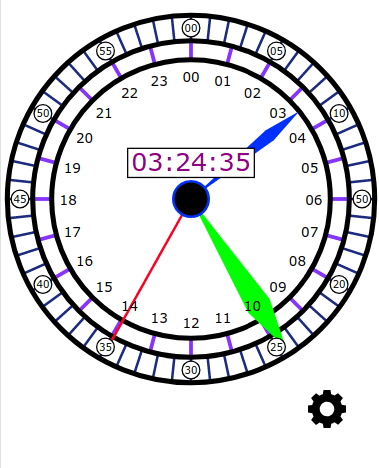
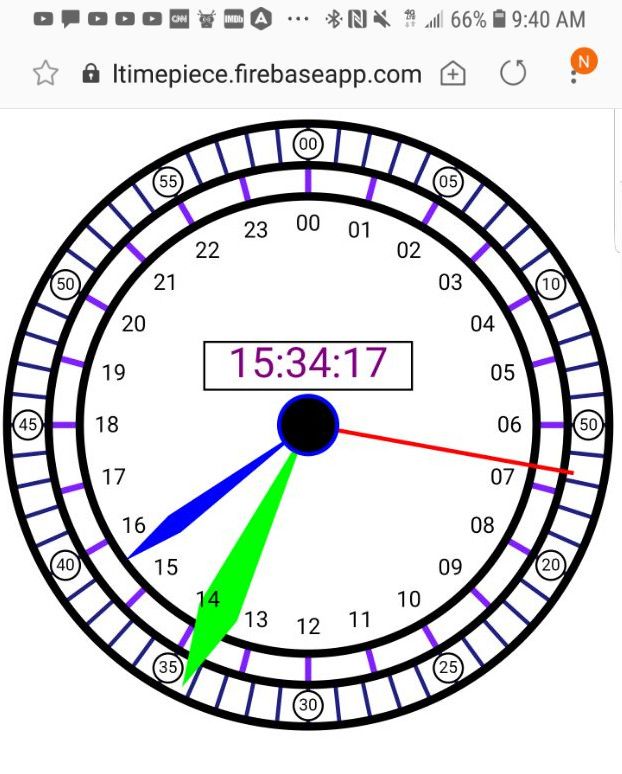
Using SVG I’ve made a simple 24 hour clock face. The clock face is really there for aesthetics. Chances are if you try to read the hands of the clock the hour hand will cause confusion since it’s position on a 24 hour clock will not meet expectations that have been formed from being able to read a 12 hour clock. The digital readout is the part that will actually give the information of interest. Every second the time is updated and the hands animate to their new position. There’s also a gear icon for opening the settings interface.
Satisfying the SSL/HTTP Requirement
A lot of the necessary features are only available if your application is being served over SSL. If you don’t see HTTPS in the address bar then these features simply will not work. To satisfy this requirement for now I’m using Google Firebase and the temporary URL that it has assigned to me. I don’t plan on keeping this URL forever, but at the time of this post you can play with the application over at https://siderealtimepiece.firebaseapp.com.
Satisfying Manifest Resources Requirements
The manifest for my application is in the root directory of the application. It is a JSON formatted file with information on where the program icons can be found, the starting URL, and the name of the application as it should appear on the user’s machine.
To satisfy the service worker requirement there’s a JavaScript file in the root of this application’s files named sw.js. The service worker works in the background behind the page. For this application we only want the service worker to do two things; respond to an install event by caching the required files locally and serve up those files when needed. The list of the files that are to be cached are in an array named urlsToCache. When the service worker response to the install event it will pass this list of URLs to a call of the addAll method on the cache object. The cache object will then download the resources at these URLs and save them locally where we can use them offline.
For the fetch event I’m using code from a Google recommendation. This handler will serve the contents from the cache when there is a cache hit and also add new files to the cache when a request is made for a file that isn’t already there.
self.addEventListener('fetch', function(event) {
    event.respondWith(
      caches.match(event.request)
        .then(function(response) {
          // Cache hit - return response
          if (response) {
            return response;
          }

          // IMPORTANT: Clone the request. A request is a stream and
          // can only be consumed once. Since we are consuming this
          // once by cache and once by the browser for fetch, we need
          // to clone the response.
          var fetchRequest = event.request.clone();

          return fetch(fetchRequest).then(
            function(response) {
              // Check if we received a valid response
              if(!response || response.status !== 200 || response.type !== 'basic') {
                return response;
              }

              // IMPORTANT: Clone the response. A response is a stream
              // and because we want the browser to consume the response
              // as well as the cache consuming the response, we need
              // to clone it so we have two streams.
              var responseToCache = response.clone();

              caches.open(CACHE_NAME)
                .then(function(cache) {
                  cache.put(event.request, responseToCache);
                });

              return response;
            }
          );
        })
      );
  });
This file must be registered as the service worker for it to be able to do anything. In one of the JavaScript files loaded by the page I check the navigator object to ensure there is a serviceWorker member (if there isn’t then the browser in which the code is running currently doesn’t support service workers). If it is there then the service worker can be registered with navigator.serviceWorker.register(path_to_service_worker).
If your code is running on a Chrome implementation that supports it you can defer the presentation of the installation prompt. In my case I’ve decided to defer it and make a button available in the settings UI. The variable installPrompt will hold the reference to the event object that when activated will present the user with the Chrome install UI. When the event is raised the variable is populated with the event object and the install button within my settings UI is made visible.
var installPrompt;


function beforeInstall(e) {
    console.log('beforeInstallPrompt()')
    e.preventDefault();
    installPrompt = e;
    $('.installUI').show();
}


window.addEventListener('beforeinstallprompt', beforeInstall);
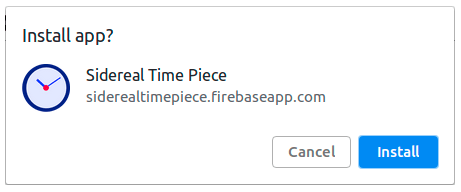
Testing the application on Chrome on Ubuntu Linux when I select my install button the Chrome install prompt shows.
The Install Prompt that shows on Google Chrome on a desktop
Program Launchers on the Desktop
On the desktop once installed the icon for the PWA shows up in the computer’s program launcher. It also shows up in the Chrome app list. When launched since this application was made to run in standalone mode the application runs in it’s own window with the OS appropriate buttons for going full screen, minimizing, and closing the window. My test application uses location services to acquire the longitude at which the sidereal time is being calculated. When run in a regular browser window I’m prompted each time I visit the page to give permission for location information. This gets a little annoying after a while. When the application is running in stand alone mode the application’s border shows an icon indicating that the location is being detected. Clicking on the icon gives the user the ability to change the location permissions for the application.
Samsung Internet Compatibility
Samsung Internet, the default browser for a long period on many Samsung phones, also supports PWAs. (Samsung Internet can also be installed on non-Samsung phones). Samsung Internet is a Chromium based browser and Samsung is one of the contributors to the Chromium project. It may come as no surprise that no code changes are necessary for this application to work on The UI it presents for installing PWAs is different than what Chrome presents. When Samsung Internet detects that a page can be installed as a PWA an icon is shown in the address bar that resembles a house with a plus in the center. Selecting it will add the icon to the home screen. The icon shows with a smaller image of the Samsung Internet icon indicating that it is a PWA. The beforeinstallprompt event will never be triggered. Since the presentation of the custom install button was driven by this event it simply will not show.
Adding iOS Compatibility
If you saw the original iPhone announcement back in 2007 Steve Jobs had announced that making apps for the iPhone could be done with HTML; at the time there was no SDK available to developers and if they wanted to target the iPhone they were making a web app that had an icon on the home screen. From 2007 to 2018 Apple didn’t do much to advance the platform. It wasn’t until March 2018 that Apple made significant updates to their support to HTML based applications. Apple added support for web manifest, and services workers, web assembly, and other features.
There’s not 100% parity between iOS and Android for available features in PWA. On iOS storage is limited to 50MB per app. On Android the application can request more storage. Android BWAs also have access to Bluetooth features, speech recognition, background sync, and other features. For my sample application none of these mentioned differences matter. While the Android implementations have UI notifications that let the user know that the app can be installed on iOS there’s no visual notification. To install the application the user must select the share option and add the page to their home screen.
Safari ignores most of the attributes of the manifest. It also doesn’t save state if the user leaves the application. So the developers must make their own implementation to save state as the user jumps in and out of the application. If you want a custom icon to show in Safari for your application Apple has a document on specifying the icon using the link tag. An icon can be specified like the following.
If you want to specify multiple icons and allow the phone to select the most appropriate one for the user’s resolution add a sizes attribute to the tag.
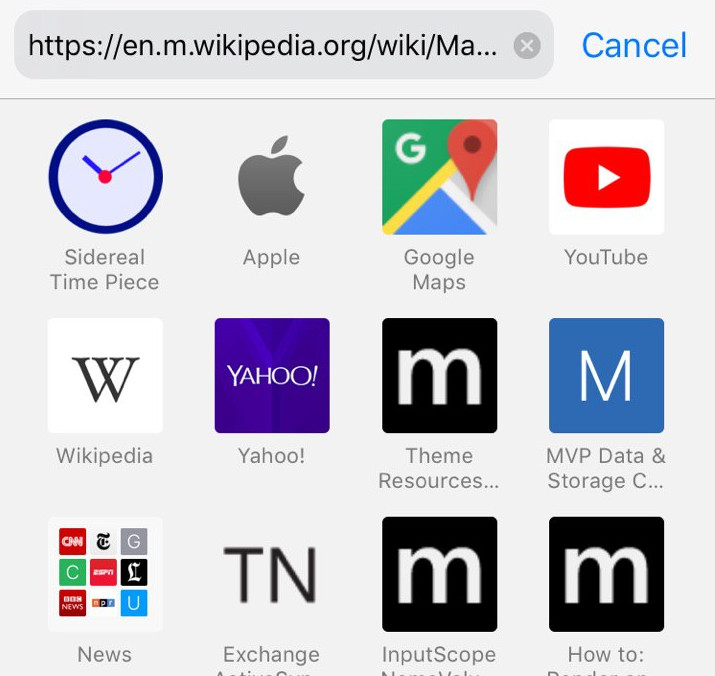
My clock icon for the program shows up in the iPhone favourites list as the following.
Offline Functionality
This application doesn’t need the internet for any functionality. It’s only inputs are the current local time and the user’s longitude. With the lack of need for any network resources and the service worker caching the required files for the application it will work just fine offline after it has been installed. If you make an application that requires network access you will want to give some thought to what to do when there is no data connection. Even if the application can’t do anything without a connection it would be better to show a friendly message than to just let the application not work.
An Alternative to the App Store
PWAs longtime might turn out to be a good alternative to app stores for some types of applications. Whether or not it is a good fit for the needs that you have will depend on the functionality that your applications require and what is available on the devices that you need to target. Apple appears to be behind on this front at the moment. But I hope that the attention that they’ve put on the platform this year to be indicative of future efforts. I’m personally am interested in what could be done when PWAs and WebAssembly are combined together. These are topics to which I hope to give a good bit of attention over the following months.
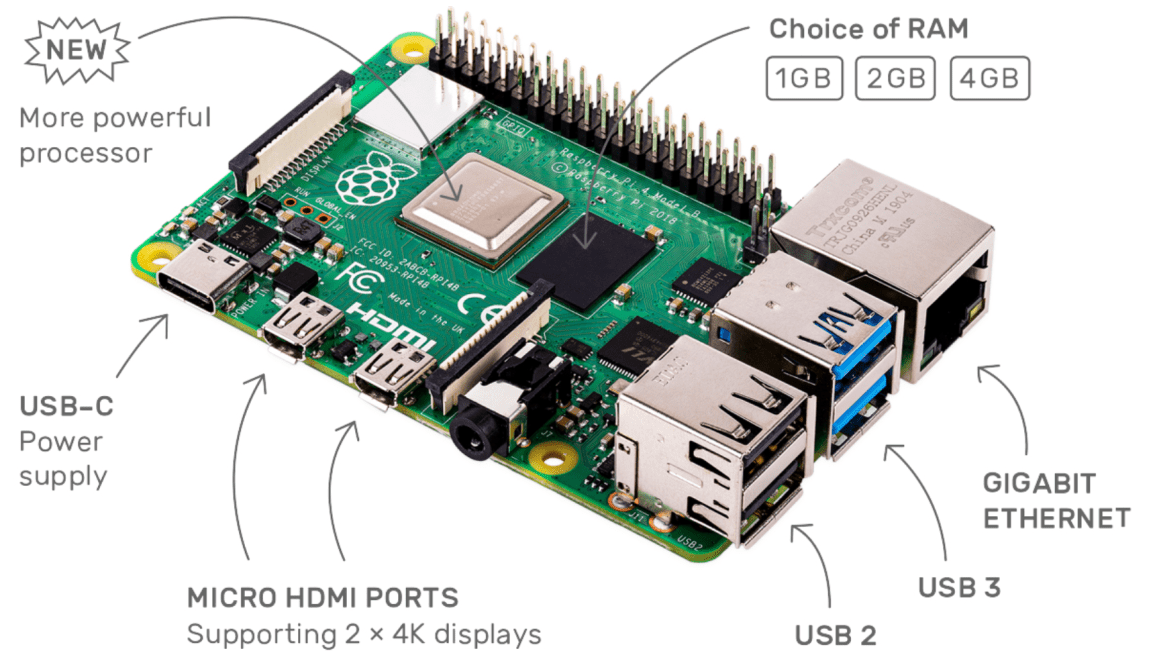
The fourth generation of the Raspberry Pi has been announced. Each generation of the Raspberry Pi is primarily identified by its specifications. (Not including the Raspberry Pi Compute module because it generally is not used by hobbyist). With the Raspberry Pi 4, this isn’t the case. There are three variations available. The new Raspberry Pi 4 comes with a 1.5 GHz ARM Cortex-A72 quad-core processor. With that processor the Raspberry Pi 4 can decode 4K video at 60 FPS or two 4K videos at 30 FPS. The amount of RAM available to the unit depends on the version. The smallest amount of RAM, 1 gig, is available for $35 USD. The next size, 2 gigs, can be purchased for $45 USD. The largest unit, 4 gigs, is $55 USD.
At first glance, the unit will be recognized as a Raspberry PI but a closer look at the ports will show some immediate differences. The Pi has converted from a micro-USB port to USB-C. The full sized HDMI port is gone and has been replaced with two micro-HDMI ports. The unit can drive two displays at once. A couple of the 4 USB ports have been upgraded to USB 3 while the other two are still USB 2. The wireless capabilities are upgraded to use USB 5.0 and dual-band 802.11ac Wi-Fi.
The unit is available for purchase from Raspberry Pi’s site now. A new case for the Pi 4 and a USB-C power supply of appropriate wattage are both available through the site as well.













 j2i.net