Setting Up for Pi Pico Development (2025)

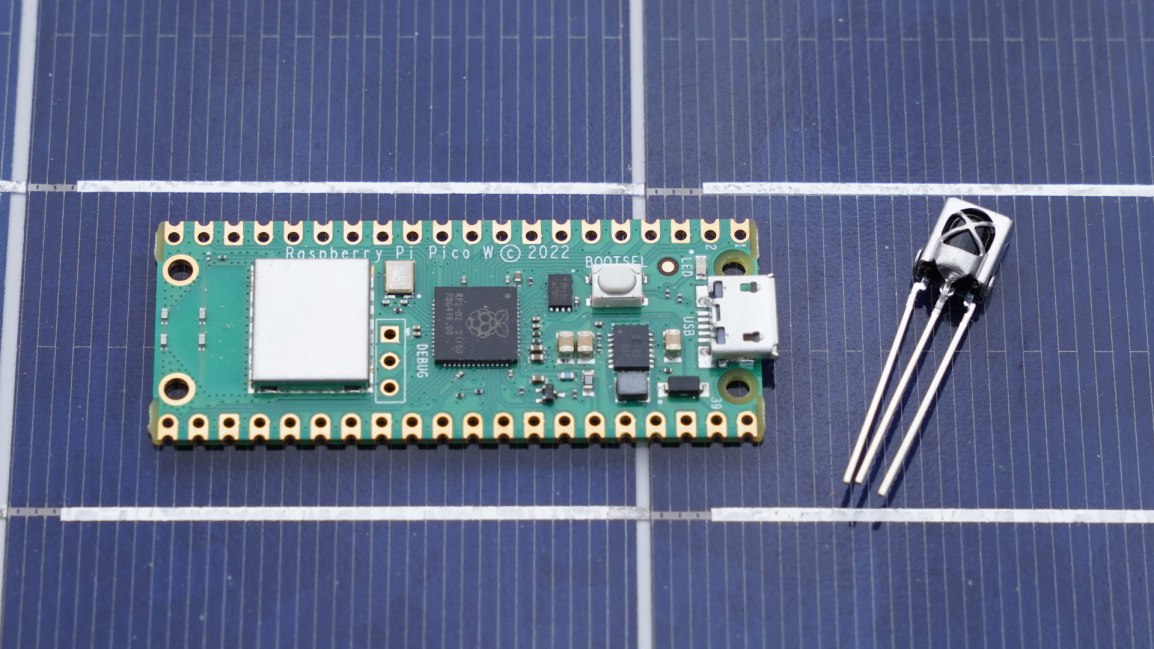
In a previous post, I mentioned that I was re-introducing myself to development for the Pi Pico. The Pico is a microcontroller, often compared to an Arduino, that can be programmed from a Linux, Mac, or Windows machine. The Pico is based on the RP2040 chip. This is an ARM based Cortex-M0 dual core processor, generally running between 125 and 133 MHz. It has 264 KB of SRAM, 2 MB of flash memory, 26 general purpose IO pins, some of which support additional functionality. The other functionality overlaid on these pins includes

  • 2 UART pins
  • 2 SPI controllers
  • 2 I2C controllers
  • 16 PWM channels

There are several development boards that use the RP2040. Collectively, I generically refer to all of these as Pico. It is a bit easier to say then “RP2040 based board.”

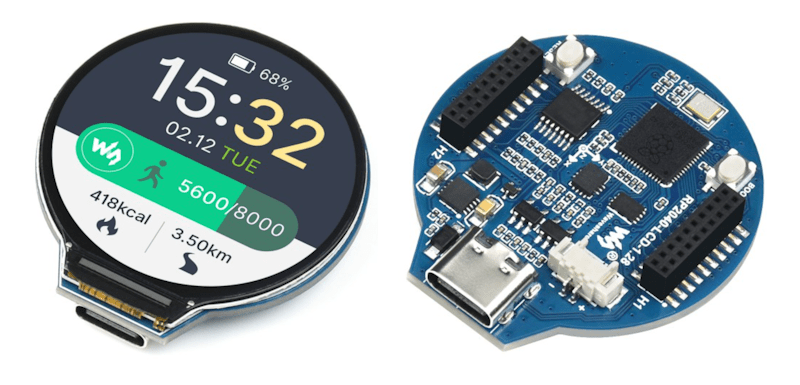
A smaller RP2040 based board by WaveShare

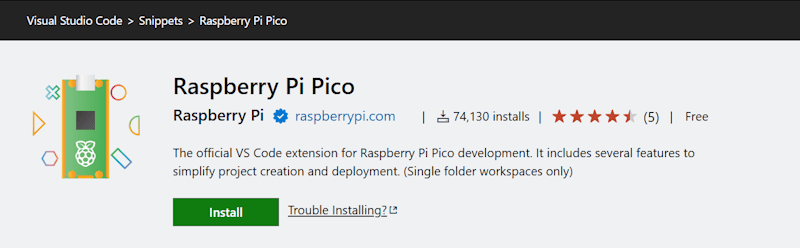
I already had a few machines setup for development for the Raspberry Pi Pico. While that procedure still works, as do those development machines, I was recently reintroducing myself to Pico development. I started with a clean installation and went to the currently published instructions for setup. The more recent instructions are a lot easier to follow; there are less dependencies on manually setting paths and downloading files. The easier process is made possible through a Visual Studio Code plugin. This extension, which is still labeled as a zero version at the time that I am making this post (0.17.3) adds project generation and sample code along with scripts and automations for common tasks. To get started, just Install the Raspberry Pi Pico Visual Studio Code Extension. Once it is installed, you’ll have a new icon on the left pane of VS Code for Pico related tasks.
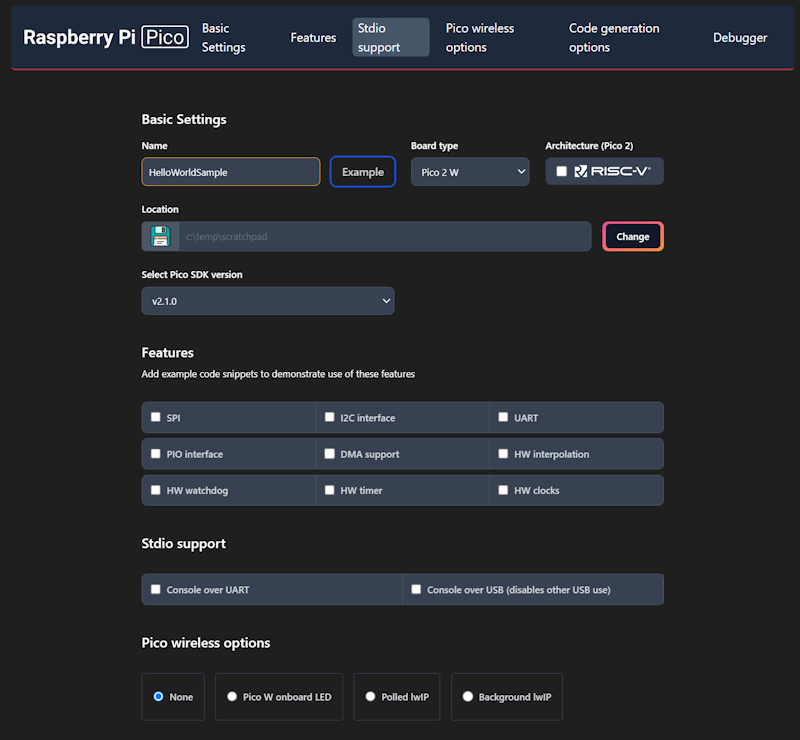
The first time you do anything with this icon, expect it to be slow. It installs the other build tools that it needs on-demand. I prefer to use the C++ build tools. Most of what I write here will be focused on that. I’ll start with creating a new C++ project. Double-clicking on “New C/C++ Project” from the Pico tools panel gets the process started.

This will only be a “Hello World” program. We will have the Pico print a message to a serial port in a loop. The new project window lets us specify our target hardware, including which hardware features that we plan to use. Selecting a feature will result in the build file for the project linking to necessary libraries for that feature and adding a small code sample that access that feature. Select a folder in which the project folder will be created, enter a project name, and check the box labeled “Console over USB.” After selecting these options, click on the “Create” button.
This is the part that takes a while the first time. A notification will show in VS Code stating that it is installing the SDK and generating the project. The wait is only a few minutes. While this is executing, it is a good time to grab a cup of coffee.

When you get back, you’ll see VS Code welcome you with a new project. The default new project prints “Hello, world!\n” in a loop with a 1 second delay. Grab your USB cable and a Pico. We can immediately start running this program to see if the build chain works. On the Pico, there’s a button. Connect your USB cable to your computer, then connect the Pico, making sure you are holding down this button as you connect it. The Pico will show up on your computer as a writable drive. After you’ve done this, take note of which serial ports show up on your computer. In my case, I’m using Windows, which shows that Com1 is the only serial port. In VS Code, you now have several tasks for your project that you can execute. Double-click on Run Project (USB). The code will compile, deploy to the Pico, and the Pico will reboot and start running the code.

Check to see what serial ports exist on your computer now. For me, there is a new port named Com4. Using PuTTY, I open Com4 at a baud rate of 115,200. The printed text starts to show there.
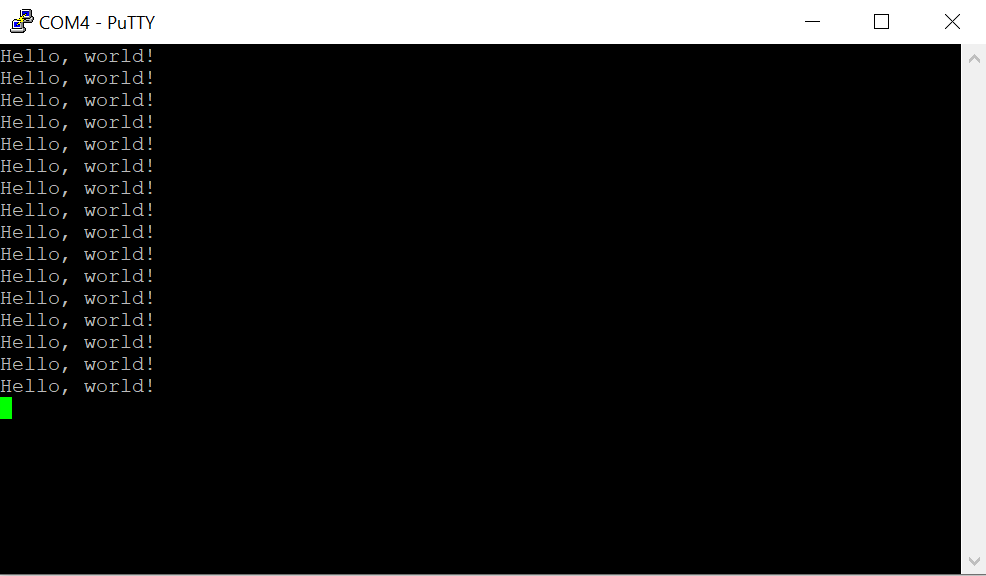
Using the USB UART for output is generally convenient, but at time you may want to use the USB for other features. The USB output is enabled or disabled in part through a couple of lines in the CMakeList.txt file.

pico_enable_stdio_uart(HelloWorldSample 0)
pico_enable_stdio_usb(HelloWorldSample 1)

The 1 and 0 can be interpreted as meaning enable and disable. Swap these values and run the project again by disconnecting the Pico, reattach while pressing the button, and then selecting the Run Project (USB) option from VS Code. When you run the code this time, the output is being transmitted over GPIO pins 0 and 1. But how do we read this?

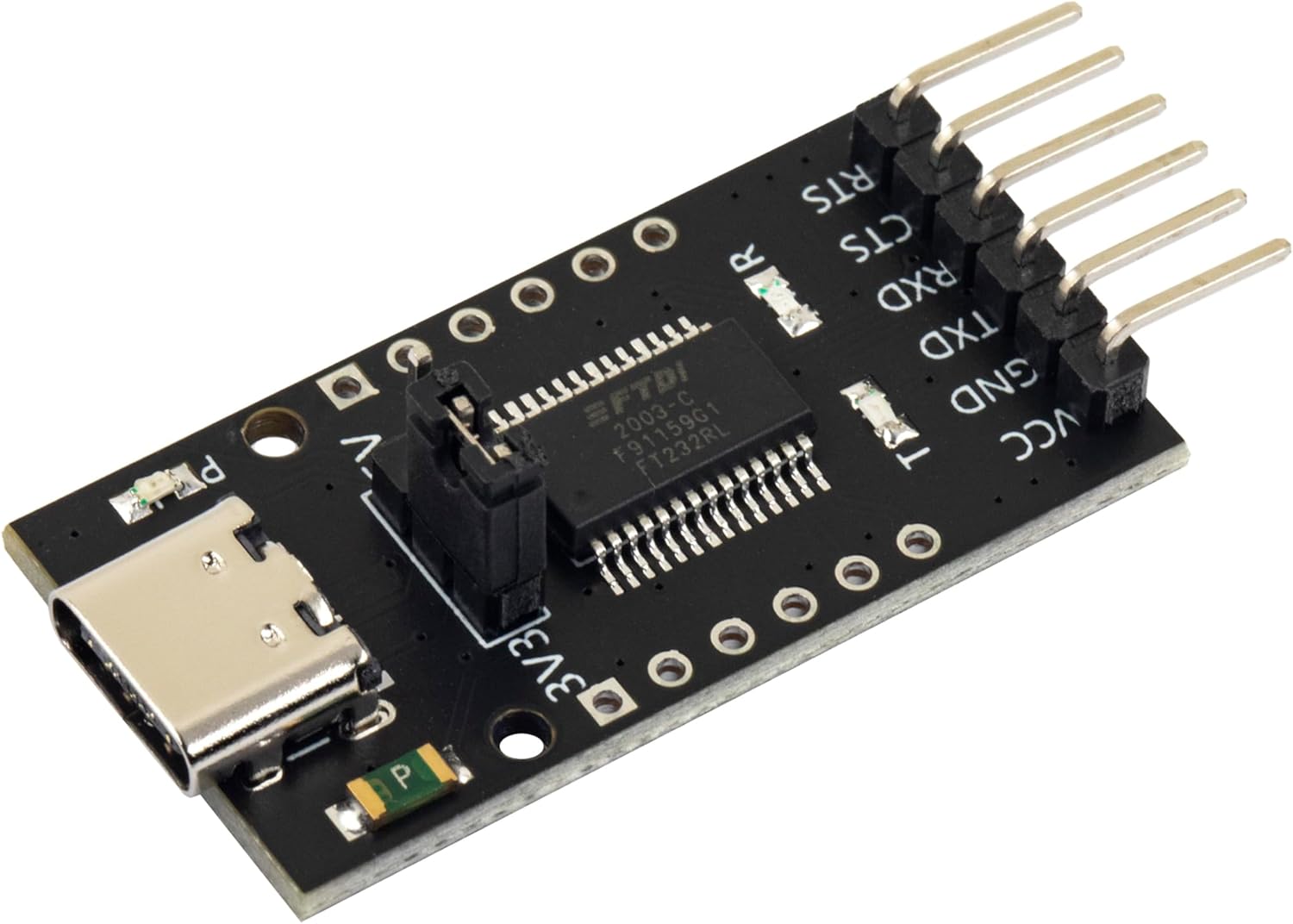
FTDI USB

FTDI is the name of an integrated circuit manufacturer. For microcontroller interfacing, you might often see people refer to “FTDI USB” cables. These are USB devices that have 3 or 4 pins for connecting to other serial devices. These are generally cheaply available. The pins that we care about will be labeled GND (Ground), TX (Transmit), and RX (Receive). The transmit pin on one end of a serial exchange connects to the receive end on the other, and vice versa. On the Pico, the default pins used for uart0 (the name of our serial port) are GP0 for TX and GP1 for RX. When connecting an FTDI device, connect the FTDI’s RX to the Pico’s TX on GPO, then the FTDI’s TX to the Pico’s RX (on GP1), and finally the FTDI’s ground to the Pico’s ground.

GPIO – Setting a Pin

Many, Pico’s have a LED attached to one of the pins that is immediately available for test programs. While many do, not all do. On the Pi Pico and Pi Pico 2, GPIO 25 is connected to a LED. On the Pi Pico W, the LED is connected to the WiFi radio and not the RP2040 directly. For uniformity, I’ll drive an external LED. I’ve taken a LED and have it connected in series with a resistor. 220ฮฉ should be a sufficient value for the resistor. I’m connecting the longer wire of the LED to GP5 and the shorter pin to ground.

In the code, the pin number is assigned to a #define. This is common, as it makes the code more flexible for others that may be using a different pin assignment. Before we can start writing to the pin, we need to gall an initialize function for the pin number named gpio_init(). After the initialization, we need to set the pin to be either in input or output mode. Since we are going to be controlling a LED, this needs to be output mode. This is done with a call to gpio_set_dir() (meaning “set direction”) passing the pin number as the first argument, and the direct (GPIO_IN or GPIO_OUT) as the second argument. For writing, we use GPIO_OUT. With the pin set to output, we can drive the pin to a high or low state by calling gpio_put(). The pin number is passed in the first argument, and a value indicating whether it should be in a high or low state in the second argument. A zero value is considered low, while a non-zero value is considered high. To make it apparent that the LED is being driven by our control of the pin (and not that we just happened to wire the LED to a pin that is always high) we will turn the light on and off once per second. In a loop, we will turn the light on, wait half a second, turn the light off, and wait again.

#include <stdio.h>
#include "pico/stdlib.h"

#define LED_PIN 5
int main()
{
    stdio_init_all();
    gpio_init(LED_PIN);
    gpio_set_dir(LED_PIN, GPIO_OUT);

    while (true) {
        gpio_put(LED_PIN, 1);   
        sleep_ms(500);
        gpio_put(LED_PIN, 0);
        sleep_ms(500);
    }
}

When we run the code now, we should see the light blink.

Up Next: Programmable IO – The Processor within the Processor

While the GPIO system can be manipulated by the main processor core, there are also smaller processors on the silicon that exist just for controlling the GPIO. These processors have a much smaller reduced set but are great for writing deterministic code that controls the pins. This system of sub-processors and the pins that they control are known as “Programmable IO.” They are programmed using assembler. There’s much to say about PIO. In the next post that I make on the Pico, I’ll walk you through an introduction to the PIO system.


Posts may contain products with affiliate links. When you make purchases using these links, we receive a small commission at no extra cost to you. Thank you for your support.

Mastodon: @j2inet@masto.ai
Instagram: @j2inet
Facebook: @j2inet
YouTube: @j2inet
Telegram: j2inet
Bluesky: @j2i.net

Rediscovering Pi Pico Programming with an IR Detector

I’ve used a Pi Pico before. But it has been a while, and I decided to jump back into it in furtherance of some other project I want to do. I’m specifically using a Pico W on a Freenove breakout board. The nice thing about this board is that all the GPIOs have status LEDs that lets you monitor the state of each GPIO visually. For those that might have immediate concern, the LEDs are connected to the GPIO via hex inverters instead of directly. This minimizes the interaction that they may have with devices that you connect to them.

Blinking the Light

About the first program that one might try with any micro controller is to blink a light. I accomplished that part without issue. But for those that are newer to this, I’ll cover in detail. Though I won’t cover the steps of setting up the SDK.

I’ve made a folder for my project. Since I plan to evolve this project to work with an infrared detector, I called my project folder irdetect. I’ve made two files in this folder.

  • CMakeList.txt – the build configuration file for the project
  • main.cpp – the source code for the project

For the CMakeList.txt file, I’ve specified that I’m using the C++ 23 standard. This configuration also informs the make process that main.cpp is the source file, and that the target executable name will be irdetect.

cmake_minimum_required(VERSION 3.13)

include(pico_sdk_import.cmake)

project(test_project C CXX ASM)
set(CMAKE_C_STANDARD 11)
set(CMAKE_CXX_STANDARD 23) #Latest C__ Standard available
pico_sdk_init()

add_executable(irdetect
   main.cpp
)

pico_enable_stdio_usb(irdetect 1)
pico_enable_stdio_uart(irdetect 1)
pico_add_extra_outputs(irdetect)

The initial source code for blinking a LED is alternating the state of a random GPIO pin. Since I’m using a breakout board with LEDs for all the pins, I am not restricted to one pin. For the pin I selected, it is necessary to call gpio_init() for the pin, and then set its direction to output through gpio_set_dir(). If you don’t do this, then attempts to write to the pen will fail (speaking from experience!).

#include <stdio.h>
#include "pico/stdlib.h"
#include "hardware/gpio.h"
#include "pico/binary_info.h"
#include "pico/cyw43_arch.h"


const uint LED_DELAY_MS = 250; //quarter second
#ifdef PICO_DEFAULT_LED_PIN
const uint LED_PIN = PICO_DEFAULT_LED_PIN;
#else
const uint LED_PIN = 15;
#endif


// Initialize the GPIO for the LED
void pico_led_init(void) {
	gpio_init(LED_PIN);
	gpio_set_dir(LED_PIN, GPIO_OUT);
}

// Turn the LED on or off
void pico_set_led(bool led_on) {
	gpio_put(LED_PIN, led_on);
}

int main()
{
	stdio_init_all();
	pico_led_init();

	while(true)
	{
		pico_set_led(true);
		sleep_ms(LED_DELAY_MS);
		pico_set_led(false);
		sleep_ms(LED_DELAY_MS);
	}
	return 0;
}

To compile this, I made a subfolder named build inside of my project folder. I’m using a Pico W. When I compile the code, I specify the Pico board that I’m using.

cd build
cmake .. -DPICO_BOARD=pico_w
make

Some output flies by on the screen, after which build files have been deposited into the folder. the one of interest is irdetect.u2f. I need to flash the Pico with this. The process is extremely easy. Hold down the reset button on the Pico while connecting it to the Pi. It will show up as a mass storage device. Copying the file to the device will cause it to flash and then reboot. The device is automatically mounted to the file system. In my case, this is to the path /media/j2inet/RPI-RP2

cp irdetect.u2f /media/j2inet/RPI-RP2

I tried this out, and the light blinks. I’m glad output works, but now to try input.

Reading From a Pin

I want the program to now start off blinking a light until it detects an input. When it does, I want it to switch to a different mode where the output reflects the input. In the updated source I initialize an addition pin and use gpio_set_dir to set the pin as an input pin. I set an additional pin to output as a convenience. I need a positive line to drive the input high. I could use the voltage pin with a resistor, but I found it more convenient to set another GPIO to high and use it as my positive source for now.

#include <stdio.h>
#include "pico/stdlib.h"
#include "hardware/gpio.h"
#include "pico/binary_info.h"
#include "pico/cyw43_arch.h"


const uint LED_DELAY_MS = 50;
#ifdef PICO_DEFAULT_LED_PIN
const uint LED_PIN = PICO_DEFAULT_LED_PIN;
#else
const uint LED_PIN = 15;
#endif
const uint IR_READ_PIN = 14;
const uint IR_DETECTOR_ENABLE_PIN = 13;


// Initialize the GPIO for the LED
void pico_led_init(void) {
        gpio_init(LED_PIN);
        gpio_set_dir(LED_PIN, GPIO_OUT);

        gpio_init(IR_READ_PIN);
        gpio_set_dir(IR_READ_PIN, GPIO_IN);

        gpio_init(IR_DETECTOR_ENABLE_PIN);
        gpio_set_dir(IR_DETECTOR_ENABLE_PIN, GPIO_OUT);
}

// Turn the LED on or off
void pico_set_led(bool led_on) {
        gpio_put(LED_PIN, led_on);
}

int main()
{
        stdio_init_all();
        pico_led_init();
        bool irDetected = false;
        gpio_put(IR_DETECTOR_ENABLE_PIN, true);
        while(!irDetected)
        {
                irDetected = gpio_get(IR_READ_PIN);
                pico_set_led(true);
                sleep_ms(LED_DELAY_MS);
                pico_set_led(false);
                sleep_ms(LED_DELAY_MS);
        }

        while(true)
        {
                bool p = gpio_get(IR_READ_PIN);
                gpio_put(LED_PIN, p);
                sleep_us(10);
        }
        return 0;
}

When I run this program and manually set the pin to high with a resistor tied to an input, it works fine. My results were not the same when I tried using an IR detector.

Adding an IR Detector

I have two IR detectors. One is an infrared photoresistor diode. This component has a high resistance until it is struck with infrared light. When it is, it becomes low resistance. Placing that component in the circuit, I see the output pin go from low to high when I illuminate the diode with an IR flashlight or aim a remote control at it. Cool.

I tried again with a VS138B. This is a three pin IC. Two of the pins supply it with power. The third pin is an output pin. This IC has a IR detector, but instead of detecting the presence of IR light, it detects the presence of a pulsating IR signal provided that the pulsing is within a certain frequency band. The IC is primarily for detecting signals sent on a 38KHz carrier. I connected this to my Pico and tried it out. The result was no response. I can’t find my logic probe, but I have an osciloscope. Attaching it to the output pin, I detected no signal. What gives?

This is where I searched on the Internet to find the likely problem and solutions. I found other people with similar circuits and problems, but no solutions. I then remembered reading something else about the internal pull-up resistors in Arduinos. I grabbed a resistor and connected my input pin to a pin with a high signal and tried again. It worked! The VS138B signals by pulling the output pin to a low voltage. I went to Bluesky and posted about my experience.

https://bsky.app/profile/j2i.net/post/3lgar7brqfs2n

Someone quickly pointed out to me that there are pull-up resistors in the Pi Pico. I just must turn them on with a function call.

those can be activated at runtime:gpio_pull_up (PIN_NUMBER);This works even for the I2C interface.

Abraxolotlpsylaxis (@abraxolotlpsylaxis.bsky.social) 2025-01-21T12:18:18.964Z

I updated my code, and it works! When I attach the detector to the scope, I also see the signal now.

Now that I can read, the next step is to start decoding a remote signal. Note that there are already libraries for doing this. I won’t be using one (yet) since my primary interest here is diving a bit further into the Pico. But I do encourage the use of a third-party library if you are aiming to just get something working with as little effort as possible.

Code Repository

While you could copy the code from above, if you want to grab the code for this, it is on GitHub at the URL https://github.com/j2inet/irdetect/. Note that with time, the code might transition to something that no longer resembles what was mentioned in this post.


Posts may contain products with affiliate links. When you make purchases using these links, we receive a small commission at no extra cost to you. Thank you for your support.

Mastodon: @j2inet@masto.ai
Instagram: @j2inet
Facebook: @j2inet
YouTube: @j2inet
Telegram: j2inet
Bluesky: @j2i.net

Installing Visual Studio Code on Raspberry Pi and NVIDIA Jetson

While it is possible to run Visual Studio Code on a Raspberry Pi or a NVIDIA Jetson, the process previously had a few challenges. With one method, a user could grab the code from Microsoft and compile it for their device. This was time consuming and required that a person perform some steps to be set up for development. An easier method involved acquiring a build from a third party source. The issue there is the user must trust the third party source. Now these are no longer issues because Microsoft provides ARM binaries for Visual Studio Code. The installation can be done on both devices with the same steps.

To install VS code, navigate to VisualStudio.com and click on the Learn More link on the Visual Studio Code box. From there, if you click on Other Platforms you will see all of the downloads that are available for Visual Studio Code. For the Jetson series of hardware you will want to download the ARM64 deb installer. For Raspberry Pi, if you are using the a 64-bit OS installation grab an ARM64 build. Otherwise grab the ARM build.

After the build has downloaded, open a terminal and navigate to the folder where you saved the ARM file. From the terminal type the following command.

sudo dpkg -i name_of_file.deb

An actual file name should replace name_of_file.deb. After a minute or two the installation completes. You can start VS Code from the command line by typing the command code and pressing Enter. You can also find it within your program files. Videos of the installation are available below.

Video of Installation for Raspberry Pi
Video of Installation for NVIDIA Jetson

Instagram LogoLinked In

Power Options for the Raspberry Pi 4

The Raspberry Pi has a few more power options than what one might gather from a quick glance. With the exception of the computer modules (which will get no further mention here) the Pis have a USB port for providing power. The Pi-4 has a USB-C port while the other units use micro-USB. In most cases having a 5-volt power supply with a the appropriate USB interface is sufficient. Using the USB interface, the Pi can be powered through a phone charger. This includes portable chargers, which might be used if the Pi needs to be placed where outlets are not available or if they must be movable. The USB port isn’t the only way to power the Pi though.

View this content in Video Form

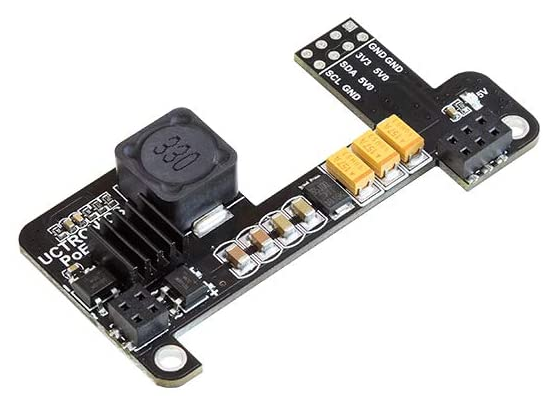
Another way of powering the Pi is through the 40-pin connector. There are pins labeled 5V and GND. these pins are often used as a voltage output. But these pins can also be used as a voltage input. Applying appropriate voltage to these pines will power the Pi on. In addition to applying 5-volts directly, there are also Pi-hats made for interfacing to these pins. On the Pi-4 and Pi-3, just behind the Ethernet connector, there are 4 pins. These pins connect to the unused connections in the Ethernet jack. With a Power over Ethernet (PoE) hat, voltage supplied over these pins can be passed through a voltage regulator and then fed into the Pi.

Pi PoE Pins

To use this there are a few conditions that must be met. If you are considering this this solution then you will undoubtedly be using the Pi with a wired network connection. You also need a means of injecting power into the network. Some routers have this functionality build in. For routers that do not, there are various forms of PoE power injectors. With this solution a headless Pi only needs one cable for providing a network connection and a the power. Such hats are available in a number of form-factors. My preference is towards the one of the minimalist PoE adapters.

This adapter leaves many of the other pins open. If cooling is needed, the official Raspberry Pi PoE hat also has a fan.

Official Raspberry Pi PoE Hat

If you have a Pi that doesn’t support PoE, you are not out of luck! You can still take advantage of it with adapters for extracting power from the extra lines and routing it to the USB input on your Pi.

PoE Extractor with Micro-USB

Another way of powering a Pi is with batteries. While it is possible to take consumer batteries (AA or AAA batteries) and power a Pi with those, I would not suggest it. There are options available with higher capacities and other features that are worth considering. In looking at a battery solution not only might you want to consider the battery capacity, but the inclusion of a real time clock and the ability to query the power level of the batteries. The most basic solutions only provided power and a USB port for charging the battery.

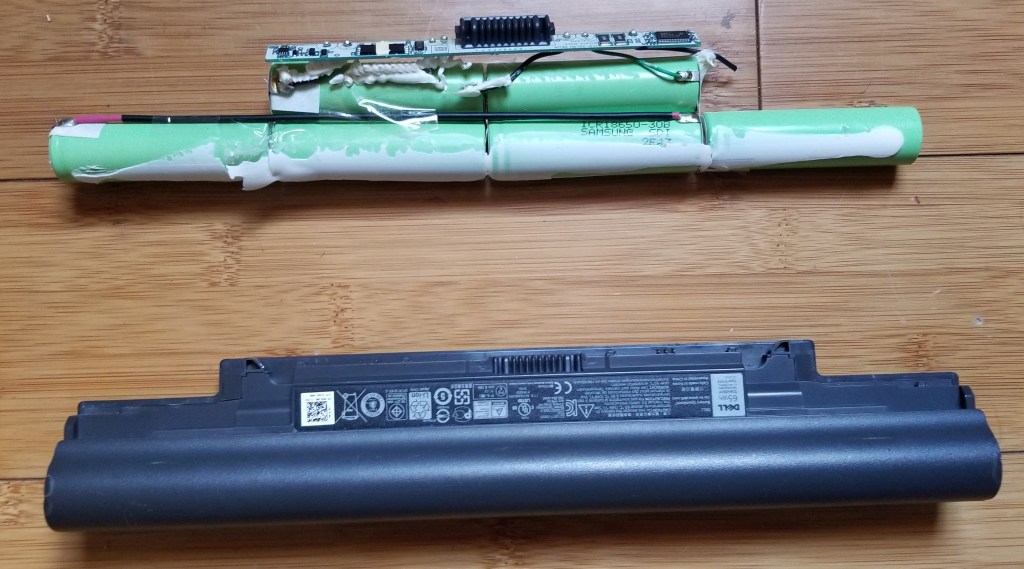
Many of the solutions use 18650 batteries. So named because they are 18mm in diameter and 65mm long. These cells look a lot like enlarged AA batteries. Even if you don’t recognize them, you’ve probably encountered these batteries before in laptop computers. Unlike the diminutive consumer batteries of similar shape, these cells rate at having a nominal voltage of 3.7 volts each. With two batteries together they are able to meet and exceed the 5-volt power requirement for the Pi. Power regulation circuits within the battery adapters ensure that the power delivered to the Pi doesn’t exceed 5-volts.

Laptop battery with the contents shown.
A laptop battery that has been opened up to show the 18650 batteries from the inside.

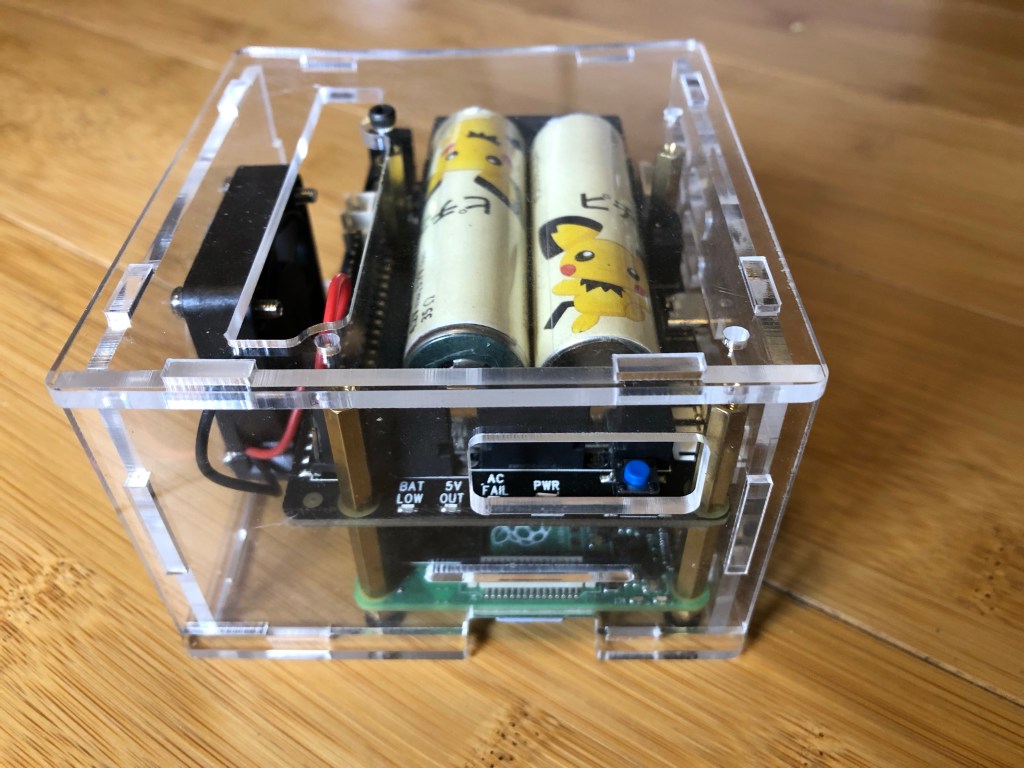
One of my favourite is the Geekworm X728. This unit contains a real-time clock and has scripts available for probing the state of the battery. The unit allows settings for having the pi automatically startup when power is applied and shutting down when when the battery level is low. For increasing the battery capacity, additional pairs of batteries can be added to the X728-A2 . The X728-A2 is made only for connecting to the X728 and add additional batteries. Though if you have the know-how, you can connect additional batteries in parallel to the ones in the X728. The board shows the power level through three LEDS on the side. There’s also a dedicated power-button on the board for powering up and shutting down.

X728 In an Acrylic Case

In close second is the PiJuice. Right now the PiJuice is a lot more expensive than the X728 at almost twice the price. But it has an additional feature; the PiJuice allows scripts to be scheduled to run under specific power or time conditions. While the battery included with the PiJuice has lower capacity than a pair of 18650 batteries, there are use cases under which it could have longer usage before requiring a charge. On the PiJuice the Pi can be put to sleep, consuming much less power, and then wake up to perform some work and go back to sleep.

The PiJuice mounted to the back of a Pi 3B

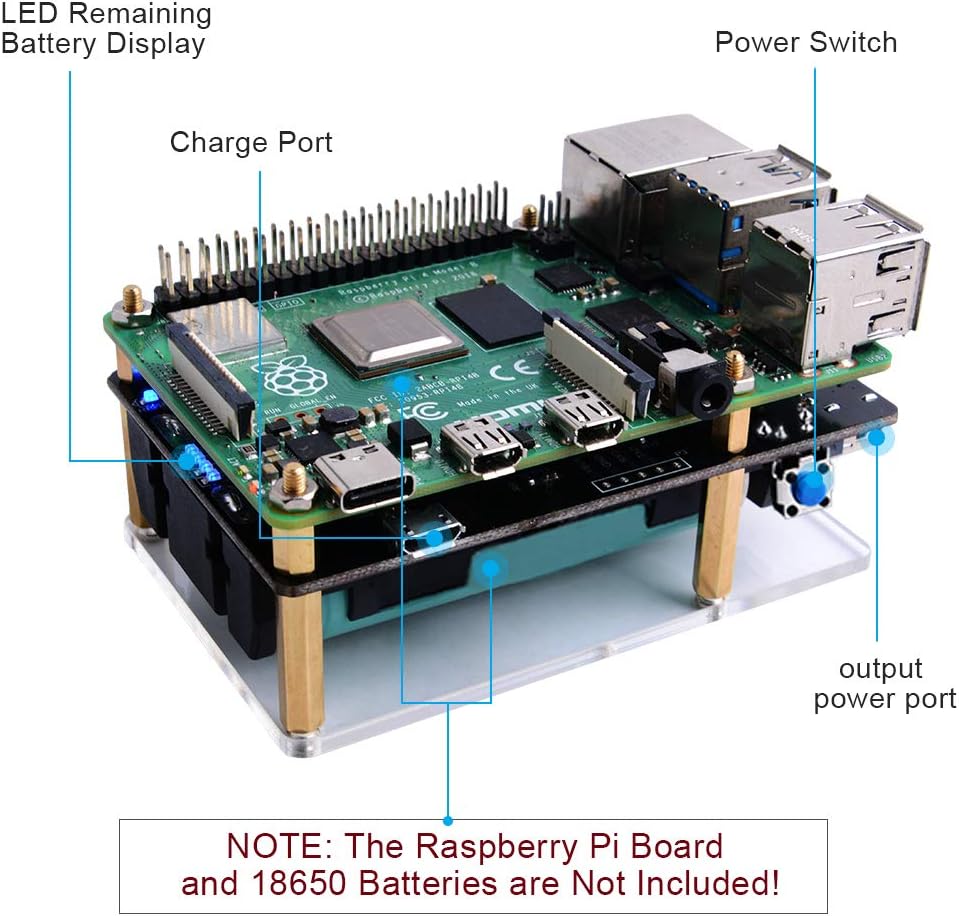
The last battery kit I want to mention is sold under various names. When I ordered one, it was branded under GeekPi. While that specific SKU is no longer available, the same unit is available branded from MakerHawk. It is often described as a UPS (Uninterruptible Power Supply). It is the least expensive of the battery kits, costing less than half the price of either of the other two. But it doesn’t have any way for the pi to detect the battery level or a way to have the Pi react to power events. It only provides power and nothing more. Like the X728, one could connect additional batteries in parallel to increase the available energy.

UPS mounted to the underside of a Raspberry Pi 4

All of the battery solutions can also function as a UPS; if external power fails your Pi would be able to continue working. I’ve been able to keep the Pis running for hours at a time (days in the case of the Pi Juice on a wake/sleep schedule). I love the overall compactness of the the battery solutions made for the Pi. Some time in the future I plan to present one of the Pi based solutions that I made using the batteries.

Instagram LogoLinked In

Posts may contain products with affiliate links. When you make purchases using these links, we receive a small commission at no extra cost to you. Thank you for your support.

USB Networking with the Pi


I stumbled upon a thread in the Raspberry Pi forums about enabling networking on the USB-C port on the Raspberry Pi 4. At first glance I thought this would be about networking with a USB-C to Ethernet dongle. It’s not. It is about configuring the Raspberry Pi to present as a network adapter when connected to another device with a USB-C cable. While this might sounds like a rather pedestrian capability at first it is something that has a lot of potential. I see using this when I want to do development on the Pi and I’m in an environment in which a network isn’t available (such as when I’m on a long plane trip) or when there’s a network but I just can’t connect the Pi to it (such as on a corporate network).ย  Additionally since I expect my Android tablet to loose it’s ability to run Linux this provides a portable dev environment in which I can put the capabilities that I need.

The basic steps in what to do can be found on this thread posted by the user thagrol. ย The steps are simple. I am re-posting the steps here.

  1. Open /boot/config.txt and add the line
    dtoverlay=dwc2
  2. Open /boot/cmdline.txt and append the following
    modules-load=dwc2,g_ether
  3. Reboot the Pi

After doing these steps when the Pi is connected to a computer the computer will see it as a networking device. If you list the network adapters on the Pi you will see a new network adapter with the name usb0.

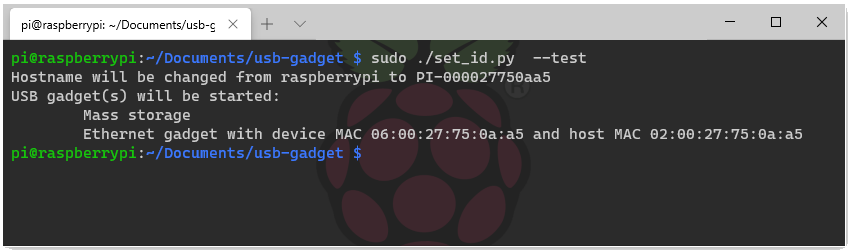
thagrol notes that the mac address generated for both sides of this virtual network adapter will be different every time that the service is started. This can cause issues when using DHCP.ย  ย He provides a solution in the form of a script that will generate a set of MAC addresses based on a unique identifier in the Raspberry Pi.ย  After cloning the GIT repository for the script run it as root.

sudo ./set_id.py --test

PiMakeMAC

Once the addresses are generated they can be added to /boot/cmdline.txt. The addition will follow this format.

g_ether.host_addr=HOST_MAC_ADDRESS g_ether.dev_addr=DEVICE_MAC_ADDRESS

In my caseย  the additional entry will be

g_ether.host_addr=02:00:27:75:0a:a5 g_ether.dev_addr=06:00:27:75:0a:a5

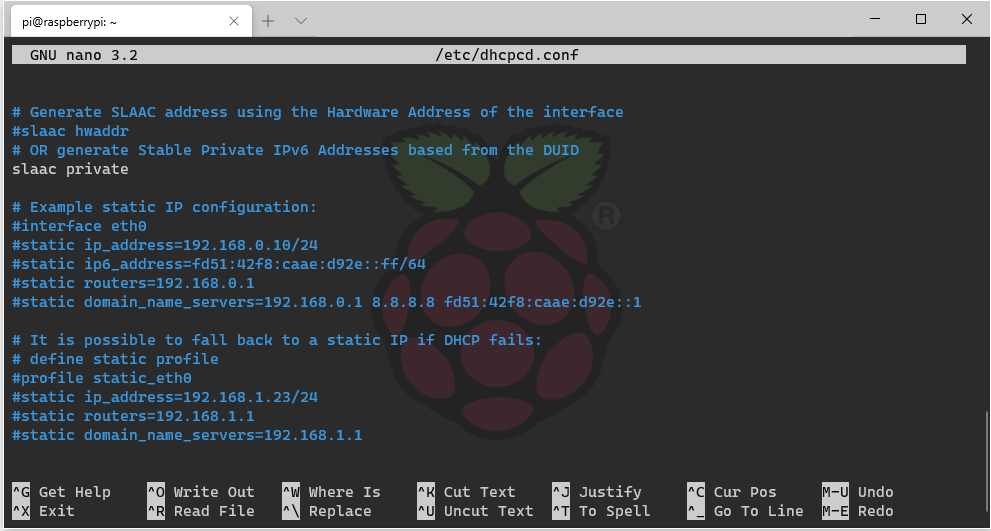
I’m going to set a static IP on my pi. To do this the file /etc/dhcpcd.conf must be edited. Scrolling to the bottom of the file commented out is a demonstration of how to set a static address.

piDHCPSettings

For the USB interface I’e added two lines to the bottom of this file

interface usb0
static ip_address=10.11.12.13/24

After rebooting the Pi now shows this address for the USB network interface. I’m connecting to my pi with a Windows machine. After physically connecting the device a static IP address was set on the Windows side.

WindowsIPSettings

To ensure that things are working I started off trying to ping the device and received positive responses.

C:\Users\joel>ping 10.11.12.14

Pinging 10.11.12.14 with 32 bytes of data:
Reply from 10.11.12.14: bytes=32 time<1ms TTL=128

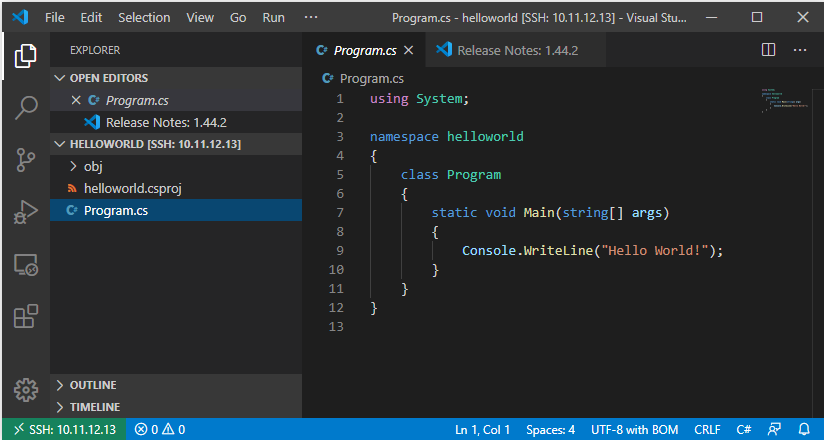
To try something a bit more functional I tried opening a folder on the Pi using Visual Studio Code running from my computer. Success!

vsRemote

In theory this could work with a phone or other mobile device. The restricting factor is whether someone’s mobile device allows changing settings on external network adapters. Many will allow communication over such adapters, but a much smaller set will allow you to change the settings.

20200507_163400.jpg
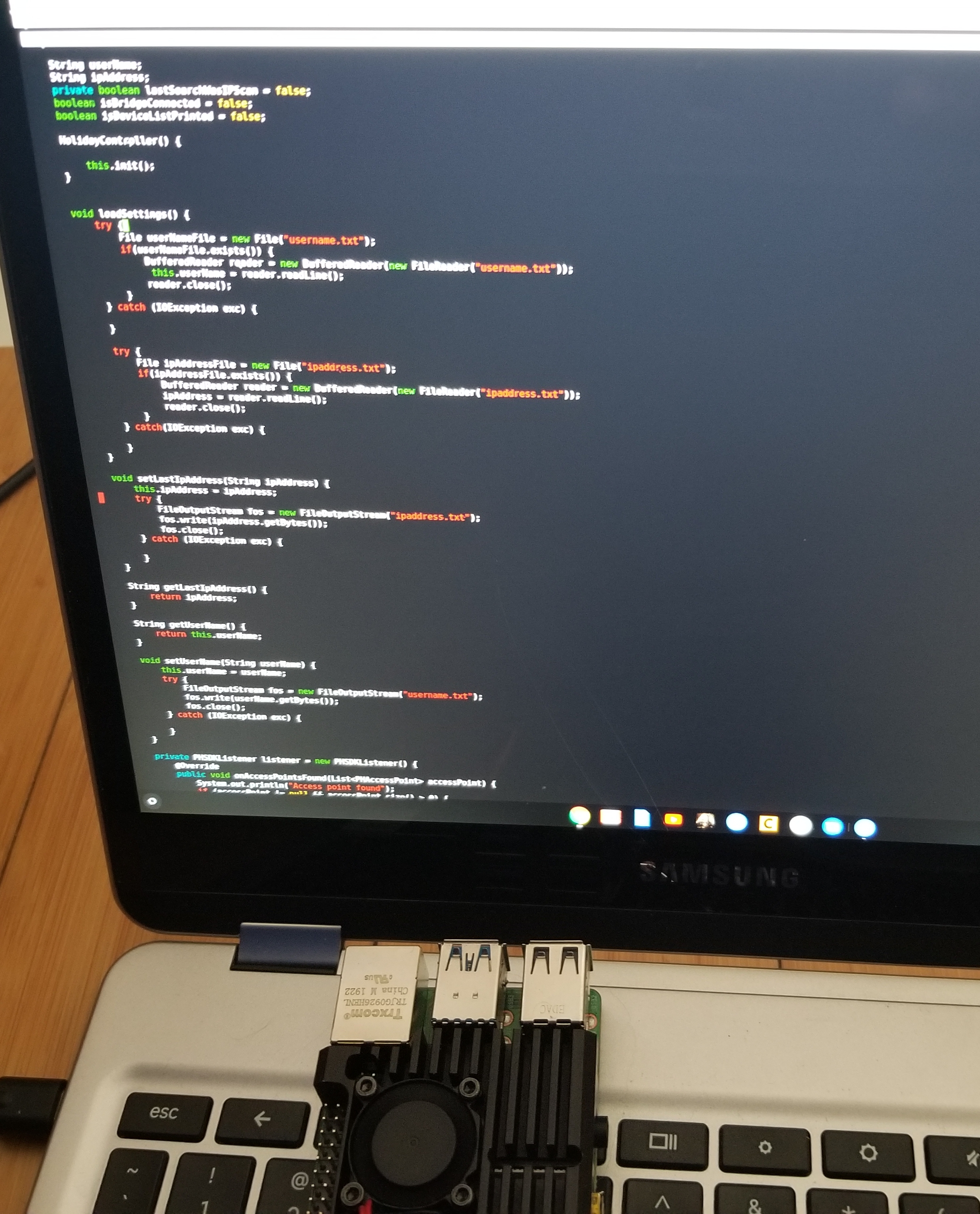
Editing a C# file on the Pi over SSH from a Chromebook

Something to note though, when using this solution on a mobile device there is a significant power drain, which makes sense; the mobile device’s battery is now working for two. There are a few ways to mitigate this but they break down to either batteries or external power. For batteries someone could add a battery to the Pi itself. There are a number of solutions that work well. I prefer PiJuice since it comes with some other options on invoking behaviours based power levels or time. Unfortunately at the time that I am writing this (during the 2020 shelter-at-home directive) this specific unit looks to be unavailable.

There are many other Pi batteries available. If you shop for one make sure that you purchase one that provides power through the headers or through pogo pens. Some provide power through the USB-C connector, which you need to keep available to act as a network connection.ย  Also give consideration to the connector used to charge the unit you select. You might prefer micro-USB or USB-C.ย  I would suggest not overclocking your Pi if it is running off of a battery. Some batteries might not be compatible with some types of cases. Ex: there is a Pi case that is essentially a heatsink that wraps the entire device. That would not work with with a power solution that uses pogo pens.

twitterLogofacebookLogoย  youtubeLogo


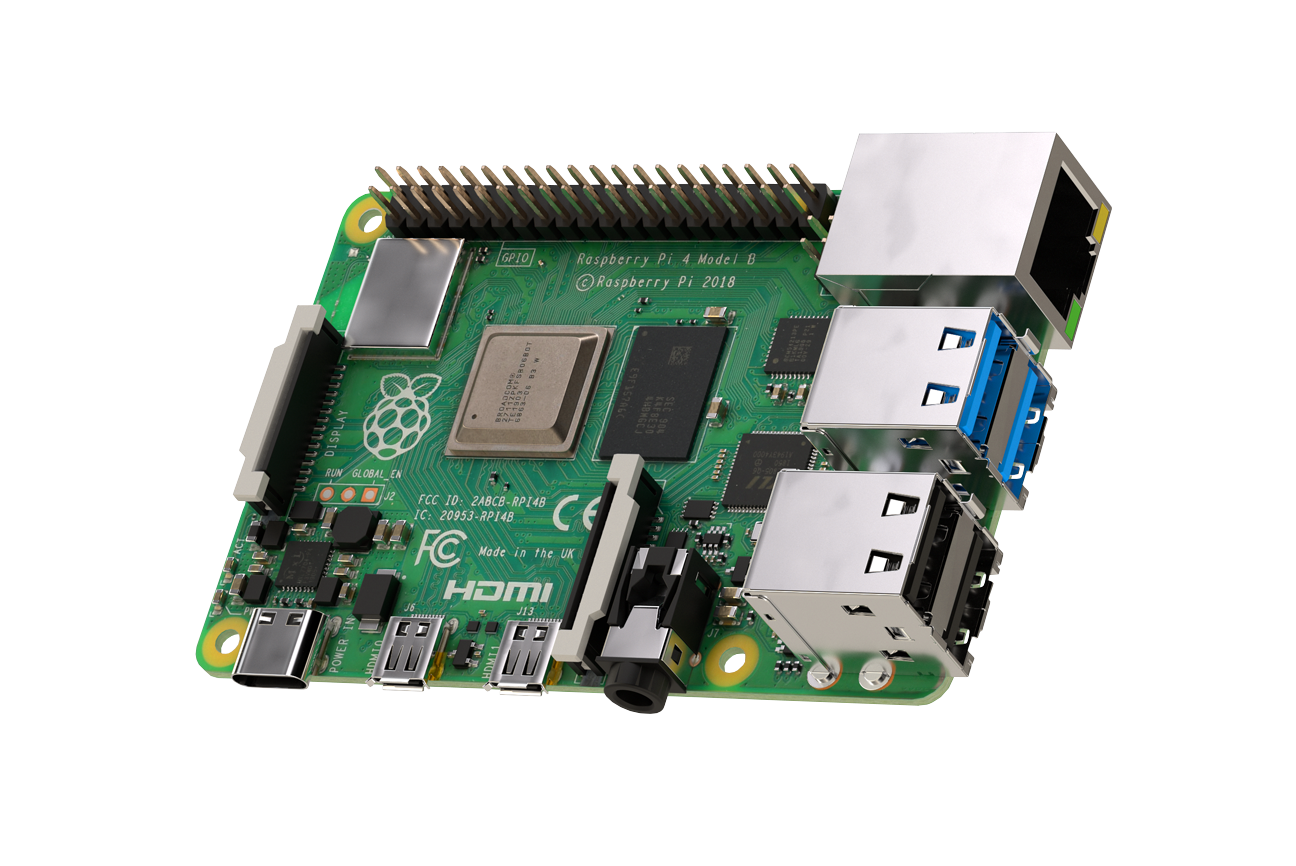
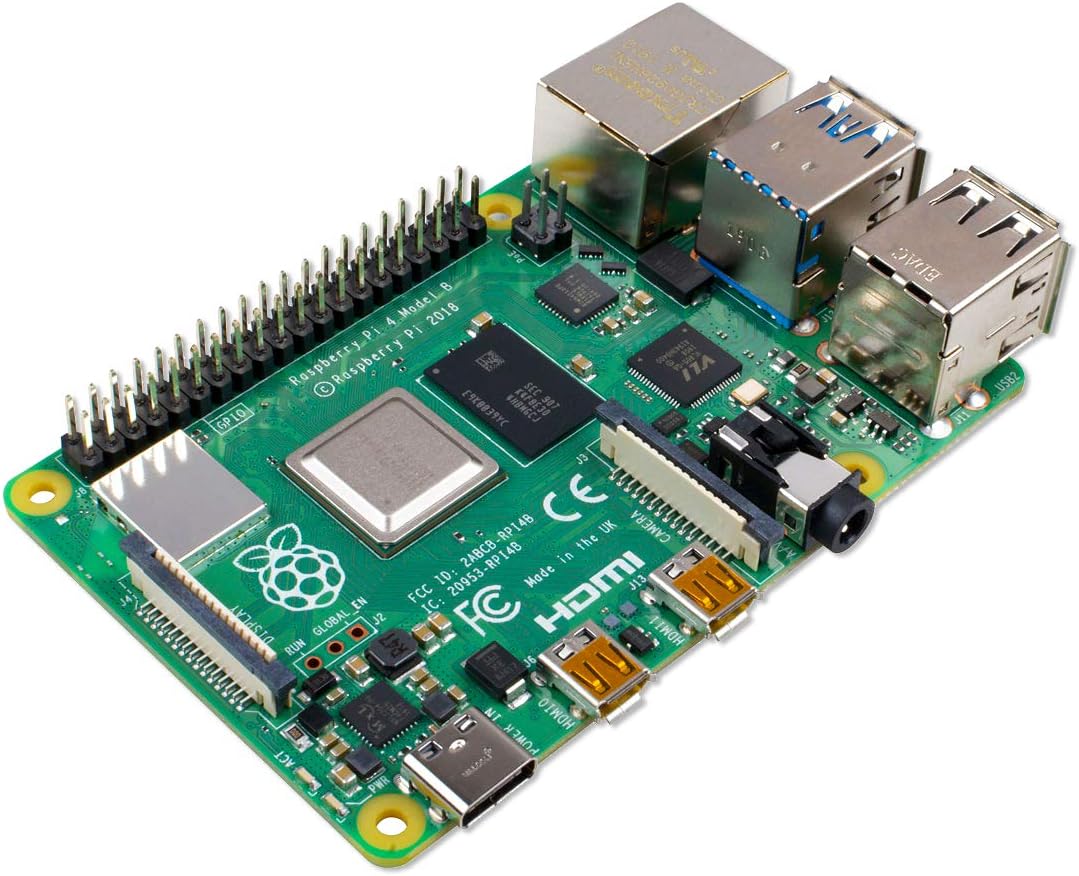
Raspberry Pi 4


GeeekPi Raspbery Pi 4 UPS Power Supply


4PK 18650 Battery

8 Gig Pi and New Jetson Board

There have been a couple of SBC updates in the past few weeks that I thought were noteworthy.

undefined


The first is that there is now a 64-bit version of the Raspberry Pi operating system available. Previously if you wanted to run a 64-bit OS on the Pi your primary option was Ubuntu. Raspbian was 32-bit only. That’s not the case any more. The OS has also been rebranded as “Raspberry Pi OS.” Among other things with the updated OS a process can take advantage of more memory.  Speaking of more memory, there is now also an 8 gig version of the Raspberry Pi 4 available for 75.00 USD.

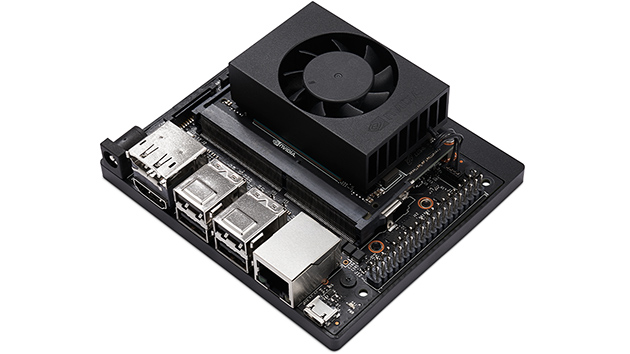
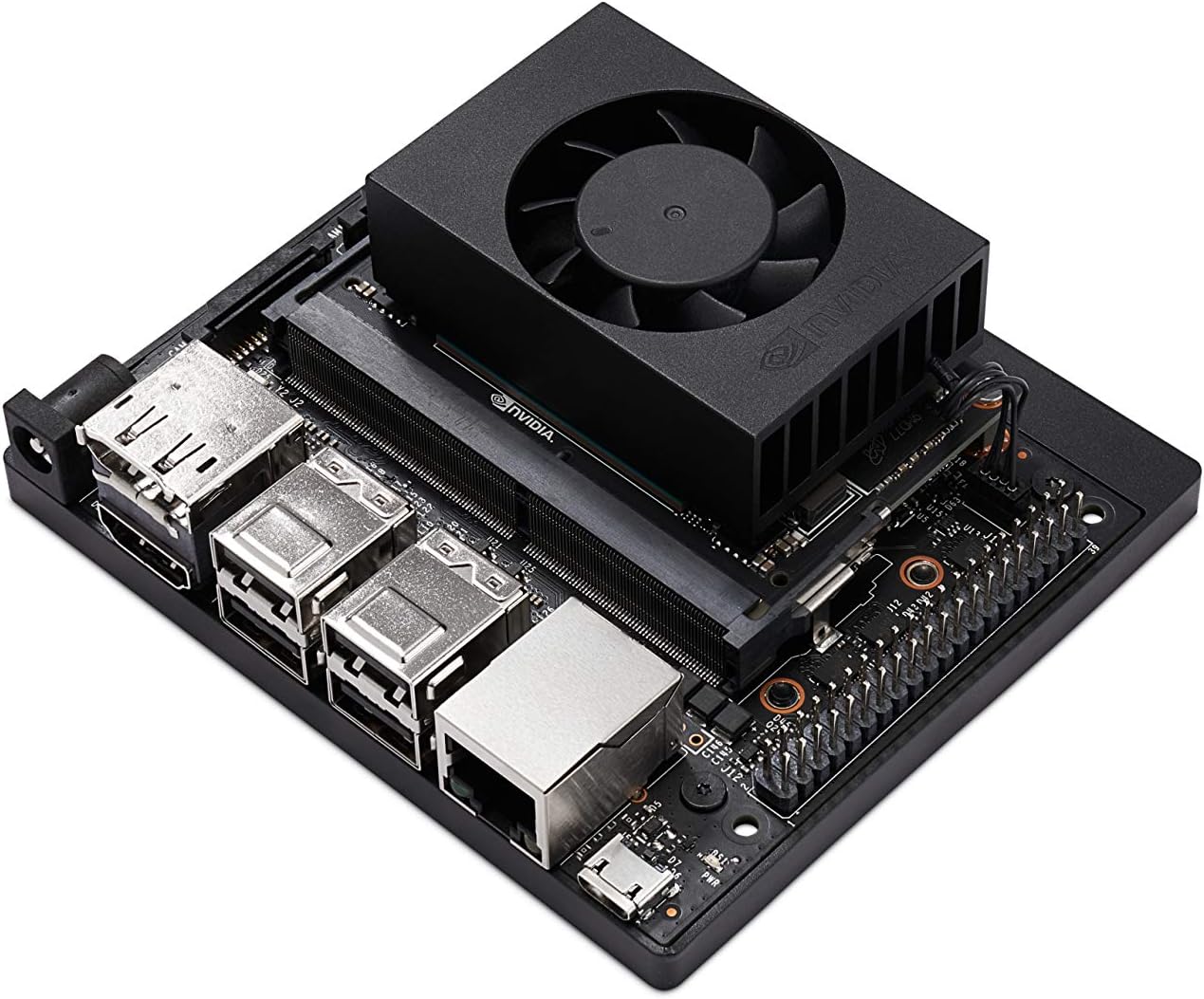
Jetson Xavier NX


Another family of single board computers is seeing an update. The Jetson family of SBCs has a new edition in the form of the Jetson Xavier NX.  At first glance the Xavier NX is easily confused with the Jetson Nano. Unlike the Nano the Xavier NX comes with a WiFi card and a plastic base around the carrier board that houses the antenna. The carrier board is one of the variants that supports 2 Raspberry Pi camera connectors. The underside of the board now has a M.2 Key E connector. While it has a similar formfactor as the Jetson Nano a quick glance at the specs show that it is much more powerful.

FeatureNanoXavier NX
Core Count46
CUDA Core Count128384
Memory4 Gigs8 Gigs

The Jetson Xavier NX is available now for about 400 USD from several suppliers.

Run .NET Core on the Raspberry Pi

Post on the NVIDIA Jetson

Instagram LogoLinked In

Posts may contain products with affiliate links. When you make purchases using these links, we receive a small commission at no extra cost to you. Thank you for your support.


Jetson Xavier NX

Raspberry Pi 4

Run .Net Core on the Raspberry Pi

The .NET framework acts as an intermediate execution environment; with the right runtime a .Net executable that was made on one platform can run on another. With .NET Core the focus on the APIs that are supported on a variety of platforms allows it to be supported on even more platforms. Windows, Linux, and macOSย  are operating systems on which the .NET Core framework will run.

The .NET Core Framework also runs on ARM systems. It can be install on the Raspberry Pi. I’ve successfully installed the .NET CORE framework on the Raspberry Pi 3 and 4. Unfortunately it isn’t supported on the Raspberry Pi Zero; ARM7 is the minimum ARM version supported. The Pi Zero uses an ARM6 processor. Provided you have a supported system you can install the framework in a moderate amount of time. The instructions I use here assume that the Pi is accessed over SSH. To begin you must find the URL to the version of the framework that works on your device.

Visit https://dotnet.microsoft.com to find the downloads. The current version of the .NET Core framework is 3.1. The 3.1 downloads can be found here. For running and compiling applications the installation to use is for the .NET Core SDK. (I’ll visit the ASP.NET Core framework in the future). For the ARM processors there is a 32-bit and 64-bit download. If you are running Raspbian use the 32-bit version even if the target is the 64-bit Raspberry Pi; Raspbian is a 32-bit operating system. Since there is no 64-bit version yet the 32-bit .NET Core SDK installation is necessary. Clicking on the link will take you to a page where it will automatically download. Since I’m doing the installation over SSH I cancel the download and grab the direct download link. Once you have the link SSH into the Raspberry Pi.

You’ll need to download the framework. Using the wget command followed by the URL will result in the file being saved to storage.

wget https://download.visualstudio.microsoft.com/download/pr/ccbcbf70-9911-40b1-a8cf-e018a13e720e/03c0621c6510f9c6f4cca6951f2cc1a4/dotnet-sdk-3.1.201-linux-arm.tar.gz

After the download is completed it must be unpacked. The file location that I’ve chosen is based on the default location that some .NET Core related tools will look by default for the .NET Core framework. I am using the path /usr/share/dotnet. Create this folder and unpack the framework to this location.

sudo mkdir /usr/share/dotnet
sudo tar zxf dotnet-sdk-3.1.201-linux-arm.tar.gz -C /usr/share/dotnet

As a quick check to make sure it works go into the folder and try to run the executable named “dotnet.”

cd /usr/share/dotnet
./dotnet

The utility should print some usage information if the installation was successful.ย  The folder should also be added to the PATH environment variable so that the utility is available regardless of the current folder. Another environment variable named DOTNET_ROOT will also be created to let other utilities know where the framework installation can be found.ย  Open ~/.profiles for editing.

sudo nano ~/.profile

Scroll to the bottom of the file and add the following two lines.

PATH=$PATH:/usr/share/dotnet
DOTNET_ROOT=/usr/share/dotnet

Save the file and reboot. SSH back into the Pi and try running the command dotnet. You should get a response even if you are not in the /usr/share/dotnet folder.

With the framework installed new projects can be created and compiled on the Pi. To test the installation try making and compiling a “Hellow World!” program. Make a new folder in your home directory for the project.

mkdir ~/helloworld
cd ~/helloworld

Create a new console project with the dotnet command.

dotnet new console

A few new elements are added to the folder. If you view the file Program.cs the code has default to a hello world program. Compile the program with the dotnet command

dotnet build

After a few moments the compilation completes. The compiled file will be in ~/helloworld/Debug/netcoreapp31. A file nameย  helloworld is in this folder. Type it’s name to see it run.

My interest in the .NET Core framework is on using the Pi as a low powered ASP.NET Web server. In the next post about the .NET Core Framework I’ll setup ASP.NET Core and will host a simple website.

To see my other post related to the Raspberry Pi click here.